
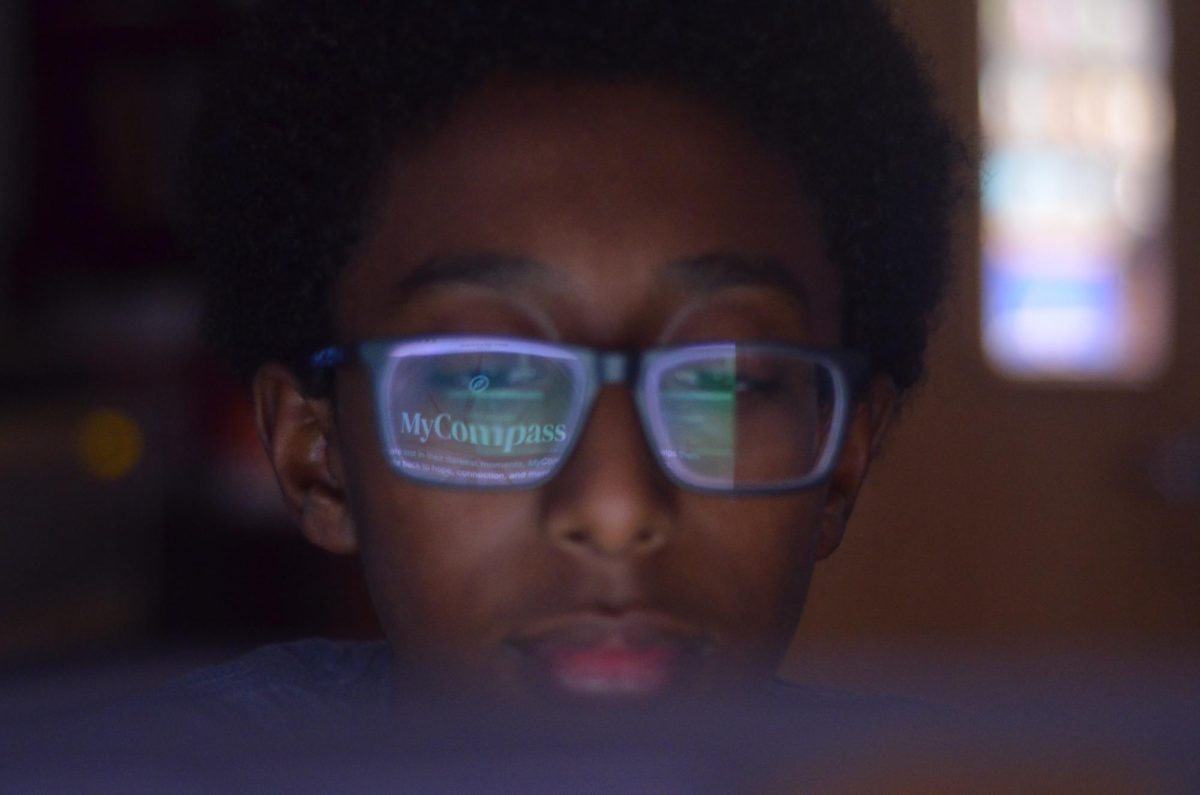
For months, freshman Emmanuel Beakal spent his afternoons experimenting with code and conducting in-depth therapy research—all to solve a systemic issue he had seen go unresolved for years in his community: mental health.
In February, Beakal’s dedication finally paid off. Beakal’s keen eye for recognizing mental health challenges across Fairfax County translated into MyCompass, which earned the grand prize at the inaugural FCPS Seize the Moment AI Challenge. An AI-powered bot utilizing Cognitive Behavioral Therapy (CBT) and Dialectical Behavior Therapy (DBT), MyCompass is an online chat simulator that provides human-like interactions to simulate therapy sessions and support individuals’ mental well-being.
“I thought [to myself,] maybe the first step I could take towards fixing the mental health problem in FCPS would be to participate in the Seize the Moment Challenge,” Beakal said. “I previously had an understanding that [in order to work with] AI, you have to be super advanced to get involved with it. When I heard this was a different kind of opportunity, I wanted to check it out.”
Growing up, Beakal has witnessed firsthand how vocalizing mental health was stigmatized throughout his childhood. He particularly recognized the negativity surrounding discussions of mental health within his Ethiopian American community.
“Especially with the [large Ethiopian population in Fairfax County], I noticed a big mental health crisis going on,” Beakal said. “I know people in our area, although not personally, who have actually lost their lives because of this.”
It wasn’t until Beakal entered McLean this fall, however, that he realized the competitive student environment had significantly worsened mental distress for his peers. Rather than ignoring those calls for help, he decided to take on the FCPS Seize the Moment AI Challenge to make a real change.
“One thing about mental health is that it [requires empathy], and the one-size-fits-all advice doesn’t work,” Beakal said. “This is why I felt I should create a mental health bot that uses evidence-driven techniques in the field to create tailored [advice] rather than a generic chatbot to help solve the problem.”
Throughout Beakal’s early drafting stages, he prioritized making MyCompass mimic human interactions as closely as possible to differentiate it from other AI assistants. To do so, Beakal focused on mitigating bias and deceptive empathy, one of the two most common issues he recognized with other tools.
“When I was working with data, I made sure that we were giving the model accurate information, because otherwise it can misinterpret certain communities and cause bias,” Beakal said. “One of the other biggest issues with this project was deceptive empathy, in which the AI model gives responses that aren’t as empathetic. They sound real but aren’t really personal enough.”
While Beakal’s mindful approach to building MyCompass initially succeeded in simulating empathy, perfecting it required proactively seeking feedback and revising the project.
“After I finished my app, the biggest [piece of feedback I received] was that it was still giving some generic advice,” Beakal said. “To fix this, I spent hours researching how a therapist speaks to their patients and how I could implement that in my app. [When revising], I told MyCompass several guide points, such as to ‘respond in less than 3 sentences’ and ‘do not ask multiple questions at a time.’”
Beakal’s main mentor, technology specialist Bridget Donoghue, also played an integral role in helping him recognize the gaps in MyCompass. While mainly assisting with his pitch, Donoghue also provided Beakal with critical information regarding concerns about using AI to treat mental health.
“Mental health apps are an area that is already being developed, but because AI-powered mental health apps are relatively new, we talked about potential risks,” Donoghue said. “As he was working on his pitch, I provided him with studies from Brown University [and] the Anxiety & Depression Association of America about ethical risks that come with AI-powered mental health apps [and] using AI responsibly in therapy.”
In addition to Donoghue’s valuable educational input, Beakal reviewed mental health data from the FCPS Youth Survey and incorporated research guidelines for CBT and DBT into his app algorithm.
“CBT and DBT are two different methods that help people reconstruct their thoughts, and it’s part of the concept of cognitive restructuring, where it tries to get people to another version of [reassuring themselves],” Beakal said. “Someone may say, ‘I’m not good enough,’ but [CBT and DBT] helps them to think, ‘I may not be good enough yet.’ It also tries to make them understand that, although they may not be at the level they want to be, they can get there.”
Beakal also implemented Claude Sonnet 4.5, Anthropic’s AI model, into MyCompass, enabling the platform to function in 10 languages, including Spanish, Chinese, Korean, French, German and Vietnamese. To further support accessibility, Beakal integrated a speech-recognition feature for users to express their stress verbally.
“Dialect is also important when sharing emotion. Typically, when you’re in the middle of a crisis, you don’t really type it out well, and it’s not going to be as effective as speaking directly to it,” Beakal said.
After months of testing, implementation and refinement, Beakal’s final product stood out among 1,100 other students’ projects in the eyes of the judges.
“Emmanuel’s project stood out for both its purpose and execution. He tackled youth mental health with a clear sense of urgency and designed his tool as a supportive resource—not a replacement for professional care,” said Gautam Sethi, chief information technology officer of FCPS and judge for the competition. “As a ninth grader, he brought a thoughtful, human-centered approach focused on making mental health support more accessible and less intimidating.”
The judges recognized Beakal with a grand-place finish, a result that left him stunned by the fruition of his efforts.
“I was in shock and disbelief when I placed first. I had been working all this time since September, and it was exciting [and] surprising at the same time,” Beakal said.
As a prize, Beakal received a $1,000 Amazon gift card funded by grants.
“I’m planning on starting a mental health non-profit for Ethiopian Americans in the Washington D.C., Maryland and Virginia area, and [hopefully] plan to use the money to go there or for other projects,” Beakal said.
In the future, Beakal hopes to continue his work in AI to improve local communities with technology.
“As Superintendent Michelle Reid stated at the competition, I want to make sure that AI is something we can shape, rather than AI shaping us,” Beakal said. “I want to be a part of that goal of getting ahead of AI by using it to specifically solve medicine [and mental health] related problems within my community.”