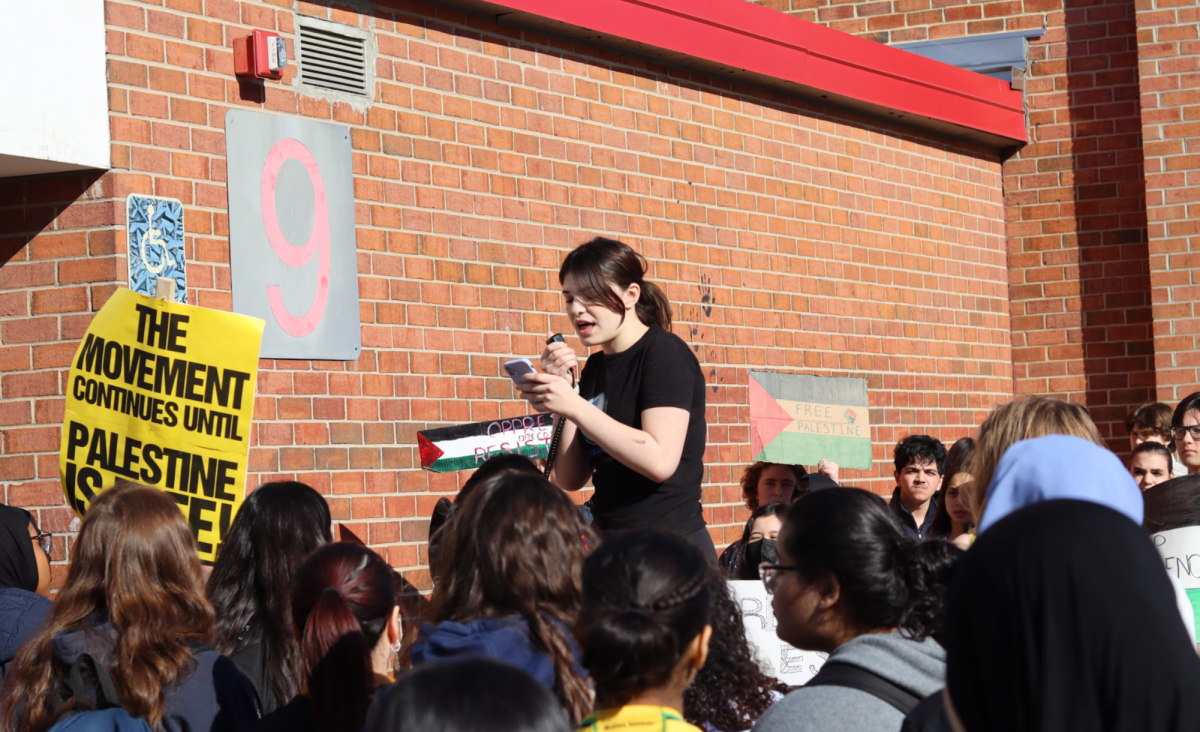
Over the past few months, students across FCPS have held walkouts to protest against raids and deportations conducted by U.S. Immigration and Customs Enforcement (ICE). As students stood up for this cause, many found themselves facing suppressive measures from school administrators.
“It seems like schools are handling punishments differently,” at-large school board member Ryan McElveen said. “Centreville High School [administrators] were telling students they would get detention if they left; some administrators [at another school] have threatened kids that they can’t walk at graduation.”
Annandale High School students planned to hold an anti-ICE walkout during class on Feb. 6.
“The principal told us we couldn’t do this and explained that what we are doing is good, but there’s new rules from last year’s
Palestine protests,” said senior Layan Dahab, one of the Annandale walkout organizers.
The principal pulled aside students the day before the walkout and laid out several reasons for canceling the demonstration.
“The principal said he didn’t want ourschool to have a bad look,” Dahab said. “[He said] it had to be before or after school hours,
and that we would have to hold the walkout the week after. He was telling us about the consequences that would happen to us and said he’d see [what they would be].”
While the organizers waited for the principal to tell them the punishments they may be subject to, teachers caused concern
among students by speculating about what the consequences could entail.
“When we asked our teachers, they were saying the principal might not let us walk on stage [for graduation] because he did something similar to a student last year who stuck up their middle finger at an Israeli flag,” Dahab said.
Despite warnings issued by administrators, students followed through with the walkout during the school day on Feb. 6. Those who attended were marked tardy for their next period.
“When we were entering the building [after the walkout], people who were going back to class had to write their names on a spreadsheet,” Dahab said.
At Centreville, students planned an anti- ICE walkout on Feb. 11. Administrators threatened participants with detention.
“[The administration] was saying that it was a safety concern, and that if students decide to participate, they would be subject to detention,” Centreville walkout organizer Sasha* said. “But I contacted Ryan McElveen, and he [talked with the principals], so they didn’t punish us.”
The walkout occurred during the last class period at a nearby location off-campus.
“When students came back to school to get on buses and cars, administrators would not let them come back onto school property,” Sasha said.
Penalties like detention go beyond what is outlined in the SR&R.
“The SR&R states that [participating in walkouts] should be a level one offense, which is equivalent to cutting class,” McElveen said. “It’s very problematic that [these punishments] are being handled differently at every school.”
These restrictions are rooted in Regulation 2612—a set of guidelines that were updated last August to mandate that walkouts be held before or after school and to give principals the authority to suggest an alternate location.
“The regulation was changed last year without my knowledge and without the board’s knowledge, as far as I know,”
McElveen said. “It was changed so that walkouts are no longer permitted during school hours, and that’s completely contrary
to the purpose of Policy 2232.5.”
In 2019, McElveen helped champion Policy 2232.5, a one-day excused absence for students to engage in civic activity, which subsequently became state law in 2021. But with recent actions overriding this policy, many are filled with uncertainty about how student activism will look going forward.
“A walkout makes something almost invisible—such as deportations, bombings or human rights violations—suddenly visible to students, parents and administrators,” said junior Bayann Hamed, an organizer of some of McLean’s previous walkouts. “If schools truly care about preparing us to be engaged citizens, they should see our protests as part of that mission, not as something to crush.”