





Trigger Warning: This article discusses sensitive topics, including eating disorders and body dysmorphia, which may be distressing for some readers. The names Jane, Sarah, Elise, Emily and Andrew are pseudonyms to protect sources’ identities.
“It’s about control.”
As senior Jane* struggled with constant social comparison and self-doubt during her junior year, she grew increasingly obsessed with what others were eating. Watching plates at restaurants, she always made sure hers was the emptiest.
“I feel awful about it, but I’ve always liked watching everyone eating at restaurants,” Jane said. “And if someone’s not eating, then I just feel terrible about myself. It’s a lot. It’s just a lot of social stuff.”
Marissa Gaines, now a PE teacher, significantly cut down on meals in college after comments from friends during Thanksgiving dinner. She would find herself exercising excessively without eating.
“I would cry if I ate an apple, thinking that was too much food, or going out to eat with my friends and just drinking water,” Gaines said.
Sarah*, a McLean parent, didn’t notice her daughter’s rapid weight loss, hidden under winter sweatshirts and pants. Within months, however, her daughter’s condition became so severe she required out-of-state residential treatment when facilities had long waiting lists and staff shortages.
Long before Sarah recognized what was happening, her daughter had developed an eating disorder.
These three people from McLean are among the 28.8 million Americans struggling with eating disorders — illnesses marked by severe disturbances in eating habits. Across high schools nationwide, eating disorder cases have increased by 107% in the past four years, according to the American Journal of Pediatrics. Within FCPS, the percentage of students who reported skipping meals to lose or maintain weight has increased 50% in six years from 6.4% in 2016 to 9% in 2023.
A months-long investigation at McLean High School involving interviews with students, parents, teachers, medical professionals, school staff and an award winning filmmaker found that eating disorders operate largely in silence. They hide behind baggy clothing and busy schedules. They’re reinforced by social media algorithms that feed vulnerable teenagers increasingly extreme content. They’re dismissed by parents and students themselves because the sufferers don’t match the stereotypical image of extreme thinness.
And they’re far more common than people realize.
What makes eating disorders so dangerous is that they impact individuals both physically and mentally. The most common forms of eating disorders are anorexia nervosa, involving severe diet restriction and fear of weight gain and bulimia nervosa, characterized by cycles of binge eating followed by purging.
“I never lost any weight because it was just eat, throw up, and starve,” senior Emily said. “It never changed.”
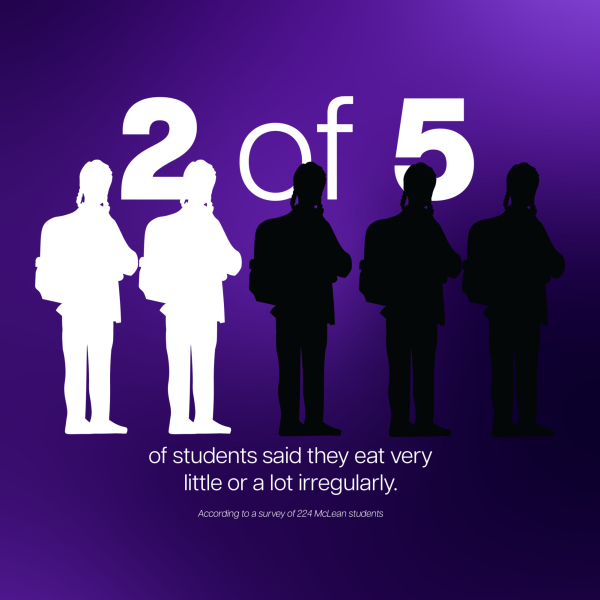
Eating disorders are deadly, having the second highest mortality rate among psychiatric diseases.
The physical effects of eating disorders are pronounced and measurable. Symptoms of eating disorders include rapid weight loss, reduction in white blood cells, lower liver function and changes in thyroid function. But sometimes, extreme weight loss fails to trigger alarms due to deceptively normal lab results.
“Someone can be very, very sick and their lab work can be totally fine,” said Dr. Elizabeth Weaver, a registered physician specializing in eating disorders. “So I have seen people who are very, very ill, very malnourished, and all of their blood work is completely normal.”
Beyond physical impacts, the mental toll of eating disorders is often overlooked in media and research. Eisha Marjara, an award-winning filmmaker who documented her struggle with anorexia in the film Am I the Skinniest Person You’ve Ever Seen?, said that the illness is worsened by psychological struggles.
“[Eating disorders] are about control,” Marjara said. “When you are able to restrict your eating, you kind of feel a bit powerful, like you’re able to have that kind of self-control and willpower that other people don’t.”
The deception to maintain an eating disorder creates profound social isolation. Students develop elaborate strategies to avoid eating with others.
“It’s very lonely because most of the time you want to hide it from people,” Gaines said. “You sometimes have to manipulate situations, you might lie, ‘Oh I’m not hungry’ or ‘Oh I just ate.’ You kind of isolate yourself from other people because you don’t want them to see that.”
Eventually, her friends stopped sending Gaines invitations. They got tired of her refusing to eat and were frustrated by the repeated excuses. The isolation became complete.
“You’re constantly being bombarded with images.”
Sophomore Lydia Ovuka stands in front of a wall of mirrors at ballet practice, her reflection multiplied across the studio. Over time, she has learned which mirror makes her appear thinner. She always tries to stay in front of that one.
“There’s always a mirror that makes you look bigger and a mirror that makes you look really skinny,” Ovuka said. “Moving around the room and seeing different versions of your body in those warped mirrors makes [body dysmorphia] that much worse.”
The constant visual scrutiny doesn’t end when she leaves the studio. It continues on her phone, where her social media feed is filled with images of dancers with “ballet bodies” — an idealistic and unrealistic body standard. One after another, posts about achieving a “summer body” and “what I eat in a day” flood her suggestions.
“It has been normalized in ballet and dance to have a really skinny body type,” Ovuka said. “It’s quite impossible to achieve. But still, everyone’s trying to get that.”
Social media has become a powerful accelerant of the eating disorder crisis. A 2023 Charles Sturt University study concluded that it only took seven minutes of watching body weight-related TikTok content for viewers to feel a decrease in their own body confidence.
“Social media has definitely increased [body dysmorphia],” Ovuka said. “Over the last couple years, more people have started talking about it, but not a lot of action has been done to change anything.”
By design, social media platforms are built to maximize engagement through algorithms proliferating content that keeps users scrolling. According to an internal report from Meta, teens who reported frequent body dissatisfaction after viewing posts on Instagram saw about three times more body-focused and eating disorder-adjacent content. Thus, the more a teen struggles, the more harmful content they see.
Apps such as FaceTune and built-in Instagram filters can slim faces and reshape bodies in a few taps. For teenagers struggling with body image, these platforms often push them deeper into harmful content spirals.
“You’re constantly being bombarded with images,” said Allison Ober, a licensed professional eating disorder counselor. “In social media, a lot of people are altering photos and editing them using filters. What we’re seeing is not necessarily an accurate depiction of what people really look like. But it’s hard to separate that when you’re seeing it all the time.”


In the past few years, wellness culture content has become increasingly prevalent on social media. Influencers without medical credentials promote untested supplements, eliminate entire food groups and post dietary advice that severely restricts consumption under the guise of health.
“When you see that all the time, you start to think maybe, ‘Oh, maybe that’s what I should do too,’” Ober said. “The people that are touting that misinformation, I don’t think that they necessarily realize what harm they’re doing.”
The harm to adolescent health has been severe enough to prompt legal action. Two 2022 lawsuits filed by families alleged Instagram’s algorithm worsened two girls’ eating disorders so severely that both attempted suicide. One required a feeding tube because she refused to eat.

But despite lawsuits, unregulated pro-eating disorder communities are thriving in deep corners of the internet. On private Tumblr spaces, users post in categories labeled “meanspo” and “thinspo.”
These harmful labels motivate eating disorders through shame.
“It’s a very strange place on the Internet,” Jane said. “People just say, ‘You are absolutely disgusting. Anything you put in your mouth, you should not and you look horrible. You need to starve yourself so that you just can feel good enough.’”
Low-profile communities persist despite moderation efforts. A Fairplay report found that over 90,000 pro-eating disorder accounts exist on Instagram, generating 20 million unique followers. To avoid detection, members intentionally misspell terms: “thinspo” becomes “thynspo” and “anorexia” becomes “anorexie”.
Moderation of eating disorder content is also severely inadequate—In March 2026, a jury found Meta and Google negligent for contributing to youth mental health distress by designing platforms to be deliberately addictive.
Yet pro-eating disorder content remains readily accessible. A survey of McLean High School students found that one-third of students have seen pro-eating disorder content on social media. An investigation by The Highlander found that it only took one search of “thinspo” and 10 seconds to surface harmful pro-anorexic content on Twitter.
“[Social media] plays a really big part [in developing eating disorders] because [there are so] many different body types online and you’re like, ‘Oh, why can’t I look like that? Why can’t I be like that?,’” senior Andrew* said.
While Gaines struggled with an eating disorder during college, she still remembers a website she stumbled upon that glorified anorexia and bulimia before such content became available on mainstream social media.
“I used to spend a lot of time on that [website], and it would give me tips and tricks on how to fool people and how to make sure you starve yourself even when you’re hungry,” Gaines said. “That glorification was not helpful.”
“She’s never taken it seriously.”
Social media platforms spread false and harmful misconceptions about what eating disorders look like. Many times, these narrow representations often prevent proper recognition.
“We have this sort of perception of a concentration camp survivor, when in fact more people with anorexia today are considered normal weight,” Weaver said.
This misconception extends beyond social media and into McLean, where parents and community members never imagine this disorder could reach their own families.
“There is a lot of misinformation and a lot of assumptions that this can’t happen in our backyard or it doesn’t happen,” Sarah said. “I did my best just to be open and honest and explain the challenges when I felt we needed to, to people we cared about.”
Eating disorders affect individuals of all body shapes and sizes. Only 6% of people with eating disorders are considered medically underweight, according to the National Eating Disorders Association.
“The stereotype is that they only affect adolescent females, white women,” Ober said. “Another stereotype is that anybody with an eating disorder is extremely thin, but that’s not always the case.”
Sometimes, even licensed professionals fail to recognize warning signs of eating disorders because a patient doesn’t fit the typical profile.
“People might assume things about your daughter because she has an eating disorder or stereotype it as something maybe that it isn’t,” Sarah said. “It was even more [misrepresented] with doctors and therapists in the beginning. There are a lot of people who are willing to dismiss the symptoms very quickly.”
Emily* said her mother never took her struggles seriously because she never fit the skinny stereotype.
“She knows [I have an eating disorder], and the reason that she’s never taken it seriously is because I’ve never gotten deathly skinny,” Emily said. “I can see why she would feel that way. It [still] affects your physical health, but it’s also a lot mentally.”
Beyond stereotypes, stigmas surrounding eating disorders prevent students from seeking help. When disordered eating behaviors go unrecognized, shame fills the silence.
“I would feel bad about overeating because of just the culture we live in,” Emily said. “And then I’d be like, ‘okay, what do I do? How can I fix this?’ I would be like ‘I can throw it up. I can do better.’”
“Is it sustainable?”
At ballet camp, senior Elise* watched her friend eat the same meal every day. A salad with no dressing, essentially just lettuce, washed down with a cup of black coffee.
“It fed into my brain that, ‘Oh, that’s what I need to be eating,’” Elise said. “It’s almost normalized to kind of feed off of each other’s bad habits.”
For athletes in competitive sports, the pressure to achieve an ideal body type has been inseparable from the pursuit of excellence. According to Telemark University College, up to 19% of male athletes and 45% of female athletes struggle with eating disorders.
Dancers like Elise spend hours every week in rehearsals, comparing themselves to their peers both on stage and off.
“Doing ballet, you’re standing in a mirror, looking at yourself in tight fitting clothes like tights and leotards for hours on end,” Elise said. “There are always other girls in class that are skinnier than you or have more of what your ideal body type would be. My mom would tell me I need to eat differently, eat less, to look like the other girls.”
When Elise returned home from her ballet camps and classes, the pressure didn’t ease – it intensified.
The pressure on dancers to starve themselves isn’t just about looking like the perfect dancer. The harmful narrative that eating less and weighing less allows dancers to improve their abilities is incredibly prominent in dance communities.
“Dancers always feel like, ‘if I’m skinnier, I’ll be able to jump higher because I’ll be lighter,’” Elise said. “‘I’ll have better technique if I look like this girl. Then everything that I do at the bar, everything that I do will look better. I’ll just be a better dancer if I starve myself,’ when that’s just like really not the reality at all.”
Eating disorders are especially dangerous due to the effects they have on both physical and mental health of those struggling.
According to the Eating Disorder Foundation, anorexia nervosa can cause heart failure; osteoporosis; lanugo, which is a layer of downy hair that grows to cover the body in order to regulate body temperature; and amenorrhea, which is the loss of menstruation in females. Bulimia nervosa can cause acid reflux, tooth decay, rupture of the esophagus and intestinal issues. Binge eating disorder can cause gallbladder disease, cardiovascular disease and diabetes.
“A real fear of weight gain, a desire for thinness [are early signs],” Weaver said. “Then you start seeing more medical complications. Slow heart rate, changes in blood pressure, hair loss, dizziness, feeling cold, feeling tired. Those are all signs and symptoms that you start seeing as someone becomes more malnourished.”
Although skinniness and health complications are signs to look out for when worrying an individual may be suffering with an eating disorder, there is no one body type.
“There’s this perception that it’s an illness of white girls, when in fact there’s a diversity of people who have eating disorders and eating disorders also affect males,” Weaver said.
If complications do start to appear in lab work, they can appear as a wide variety of different issues.
“The sort of things I more commonly see are a drop in the white blood cell count, so a sign that the immune system is not working well enough,” Weaver said. “White blood cells are made in the bone marrow, and you can start seeing replacement by fat in the bone marrow and the lack of production of white blood cells. Liver function tests also start to rise.”
“You are not alone.”
Sarah didn’t sleep much those months. She was up at night running through the same questions—how did this happen so fast, how did I miss this and what I can do to help my child.
“[Having a child with an eating disorder] is exhausting because you’re up worrying all the time about how to help your child recover,” Sarah said. “I mean [it’s] gut-wrenching really, as a parent watching your child go through that. There’s nothing worse.”
Sarah faced difficult decisions regarding her daughter’s treatment. Local treatment facilities had waiting lists due to COVID-19 staff shortages, but going out-of-state would mean extended time away from her child. Despite this frightening option, Sarah ultimately settled on sending her daughter for a residential treatment program out-of-state.
“No parent ever wants to send their child away [because] you lose control with that,” Sarah said. ”You just have to trust the experts. It was a very scary decision to make.”
Recovery looks different for everyone. For some, resolving eating disorders doesn’t involve intense intervention. Andrew, a student who struggled severely with emetophobia—an intense fear of vomiting —which progressed to an eating disorder, eventually recovered without any formal treatment.
“I kind of grew out of [the fear],” Andrew said. “I didn’t really know when the switch happened.”
While some with eating disorders can recover quickly, many require intensive, sustained intervention. Eating disorder treatment programs progress through multiple levels of care, from outpatient facilities to full-time residential ones. But regardless of the treatment plan, recovery is difficult. Sometimes, relapse may follow improvement. According to the Eating Recovery Center, a third to one half of individuals seeking anorexia treatment will relapse within a year of discharge.
“I had kind of gotten out of it in high school, but going to college, coming back from break and gaining the freshman 15, people made comments,” Gaines said. “And I was like, ‘Oh, yeah, that’s not fun.’ And so then I was like, I can fix that. And then I spiraled again.”
Even after patients normalize eating patterns, the psychological effects can still remain.
“Eating disorders alter your brain chemistry,” Weaver said. “And sometimes that is something that they will have to deal with for all of their lives. It doesn’t go away.”
The cost of recovery presents another challenge. For lower income households, this cost may be more than they can afford, even if it is necessary.
“Among my lower income students, [eating disorder treatment cost] is not addressed as readily as it is among our higher income students,” school social worker Marly Jerome-Featherson said. “Many providers probably wouldn’t accept Medicaid, and if they did, they would probably accept only a few patients with that insurance.”
Insurance providers often determine when treatment should end based on BMI rather than psychological readiness, forcing patients to reduce care.
“The insurance pays for [treatment], but it’s the insurance that decides when you’re ready,” Sarah said. “For my daughter, it was particularly detrimental because they said once she was at a healthy weight that she was fine to go, but she still had more work to do.”
Healing also requires finding a purpose beyond eating disorders. In Marjara’s case, her passion for filmmaking served as inspiration to overcome her eating disorder.
“Around the time [I was getting treatment] I was like, ‘I want to be a filmmaker,’” Marjara said. “So that was around the time that I started to really search for what it was I wanted to do. I was able to see the end of the tunnel and that was, the end of the tunnel, was me becoming a filmmaker.”
Decades after first entering treatment as a teenager, Marjara returned to one of the most difficult chapters of her life to create a memoir about her struggle with eating disorders. She hopes that documenting the fears and insecurities that once consumed her can now serve as a way to reach people who may still be struggling.
“I made this film to emphasize that growing up [with eating disorders], it was really hard,” Marjara said. “We need to be really kind to ourselves and support each other through this process and see that it is a big deal.”
At McLean, students play the most important role in supporting struggling peers. Simply being present and maintaining friendships can mean a world of support to those with eating disorders.
“[Eating disorders] run the gamut of emotions,” Sarah said. “There were a lot of people there to support us.”
Acting early is necessary to overcoming eating disorders. Parents, teachers and community members should voice concerns if signs of eating disorders are apparent.
“Always focus on your gut instinct,” Sarah said. “You always have to go with your gut and fight hard for your child if you think something’s wrong.”
Recovery is possible. For McLean students facing eating disorders and for those who are struggling for control, help exists. Seeking support doesn’t require waiting until you feel sick enough to need it.
“There is no shame in eating disorders at all,” Marjara said. “It’s serious, it’s treatable and you can overcome it.”