High school athletes, often caught between their academic and athletic responsibilities, are forced to constantly balance practice, schoolwork, and a social life. The demands of their sport can cut into the time they need for school, and the pressure to excel in both areas can create feelings of inadequacy, leading to anxiety or depression.
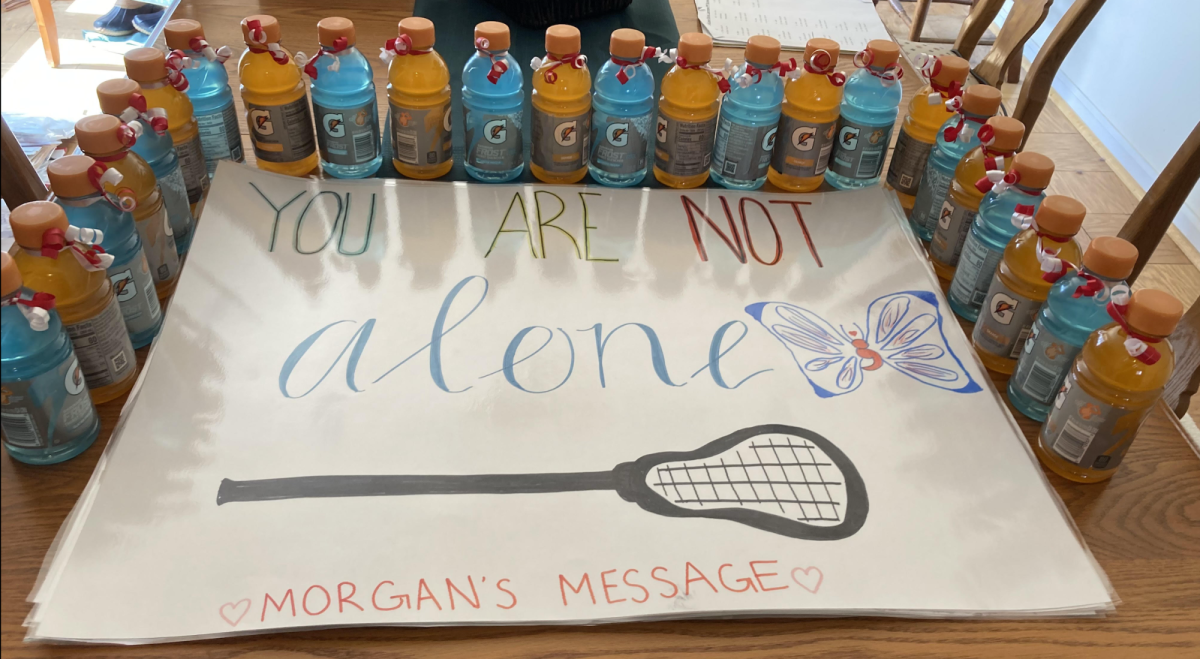
Morgan’s Message is a 501(c)(3) nonprofit that was created to share the story of Morgan Rodgers, and eliminate the stigma surrounding student-athlete mental health, as well as equalize the treatment of physical and mental health in sports. There are a number of reasons an athlete may experience sports burnout, and Morgan’s Message recognizes both the athlete’s external environment and their internal dialogue.
“We aim to expand the dialogue on mental health by normalizing conversations, empowering those who suffer in silence, and supporting those who feel alone,” Co-Founder Elise Koehl said. “Sports is an incredible outlet for the world around us, when the environment is positive.”
Rodgers grew up in Northern Virginia, and was an incredible lacrosse player, committing to play at the Division I level at Duke University in 2014. Koehl had grown up playing with Rodgers, and even competed against her in college.
In January 2017, Rodgers endured a dream-shattering knee injury, and then spent the next year dedicated to returning to lacrosse. However, she still struggled with the change, feeling as though she had lost all sense of control. She remained strong in front of her community, yet felt isolated, and as though she was not living up to her expectations. Rodgers struggled with anxiety and depression in silence, keeping friends and family in the dark. As a result, she died by suicide on July 11, 2019 at the age of 22.
“Although her life was cut way too short, Morgan’s legacy of unconditional love remains,” Koehl said. “Her energy empowers those she has left behind to transform devastation into action. We elevate her story to provide a platform where others feel safe to share their own, be a catalyst for change within our mental healthcare systems and foster a community for which tomorrow always exists.”
The Morgan’s Message Education (MMEP) is the most effective peer-to-peer initiative offered. MMEP supports volunteer student-athletes, also known as Ambassadors, attending high schools, colleges or universities across 46 states in the United States, Canada, England, Germany, and South Africa. Today there are 5,534 Ambassadors on 1,717 campuses, including at McLean.
“President Brooke Buursink and I are national ambassadors for Morgan’s Message, so we have a lot of understanding and connections to it,” said junior Eva Braccia, treasurer of McLean’s Morgan’s Message chapter. “Our mission is to spread awareness about athlete mental health and the stigma that surrounds it.”
At McLean, Morgan’s Message has a chapter run by members of the girl’s lacrosse team and other girls sports. They organize dedication games that honor Rodgers and helps share her story and the mission of Morgan’s Message at the beginning of the game, and hold fundraisers and other activities to spread awareness.
“The dedication games between teams highlight awareness for student-athlete mental health,” Braccia said. “We often give our bracelets and stickers and they tell Morgan’s Message and her story before the game.”
As one of Rodgers’ best friends, Koehl is very involved in Morgan’s Message, aside from helping co-found it. She’s extremely passionate about the mission, specifically making sure athletes do not feel as though their mental health struggles are overlooked or not important.
“When an athlete sprains their ankle, they rehabilitate with a physical therapist every day until they feel ready to get back to their sport. When an athlete experiences mental health struggles, they may get sent home for the day or told to shake it off,” Koehl said. “This is an antiquated way of supporting athletes. Our physical health depends on our mental health; we can only perform 100% when we are feeling good mentally. Equalizing the treatment of mental and physical health is essential for the future of athletics.”
Koehl has coached lacrosse for a variety of teams, from travel clubs to starting programs at public schools. Though she is not a professional in the mental health field, she uses her experience and position to empower the communities around her.
“I bring Morgan’s Message to every athlete I work with, sharing my story and providing an outlet for those who are passionate about the mental health movement,” Koehl said. “I strive to create a safe space for anyone who feels alone and provide the necessary resources to seek support.”
For athletes around the world, Morgan’s Message serves as a resource to student-athletes and can help them feel safe when experiencing burnout or mental health struggles. The team works hard to foster communication in the athlete community and make sure anyone who needs help gets it.
“Morgan’s Message is clear,” Koehl said. “As an athlete, there is no shame in seeking physical healthcare–the same should be true for mental healthcare. In order to close the gap, we must eliminate the stigma surrounding mental health together.”