*The Editorial Board consists of editors-in-chief, managing editors, and two randomly selected staff members. On this issue, the board voted unanimously in favor.
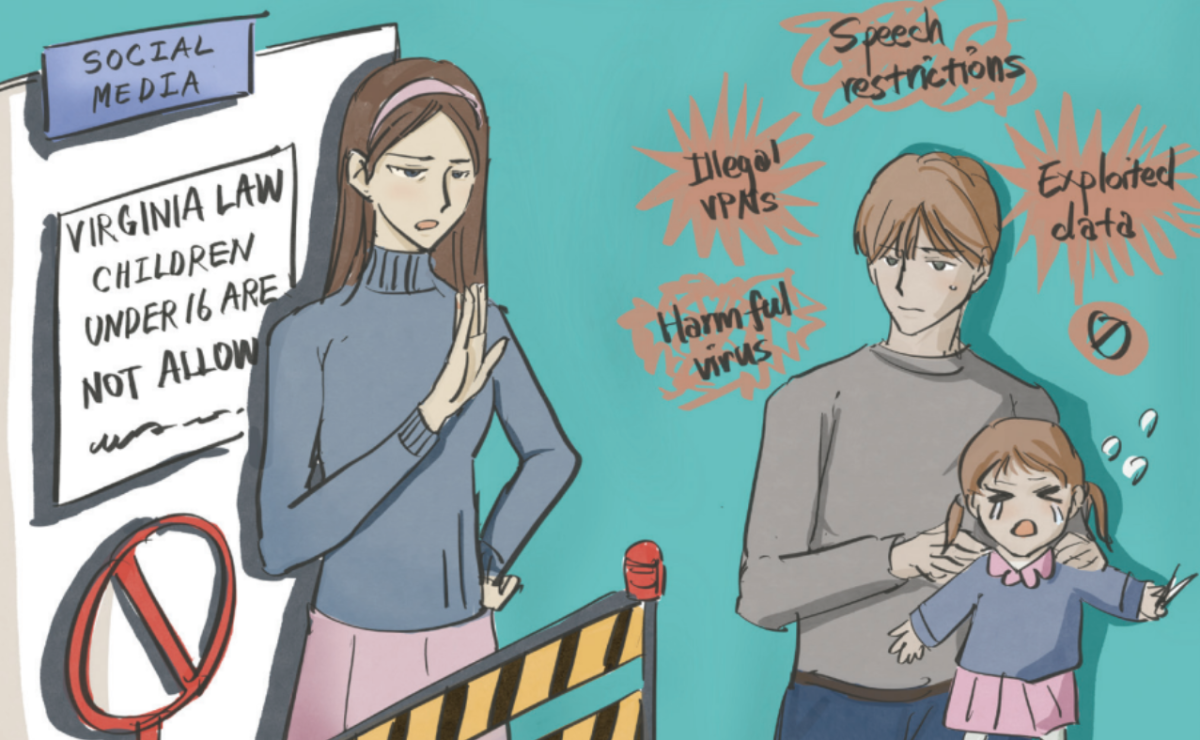
With the start of a new year, Virginia implemented a policy limiting the amount of time minors can spend on social media. This means that kids under the age of 16 are no longer allowed to browse platforms such as TikTok, Instagram and YouTube for more than an hour per service.
While the law attempts to address widespread social media addiction among young people, it infringes on minors’ constitutional rights and doesn’t address the crux of the issue. Instead of relying on a blanket government ban, Virginia should continue to leave social media regulation solely up to parental discretion.
In response to Virginia’s law, NetChoice—an internet advocacy group comprised of large companies such as Google and Meta—has already filed an injunction against Virginia, arguing that the law infringes on minors’ First Amendment rights. The concerns outlined in the injunction are valid; the Supreme Court has repeatedly established that minors have First Amendment rights online, including the right to receive and express speech.
A government limit directly and harmfully infringes on those rights. Social media is one of teens’ primary sources of information—in Deloitte’s 2025 Digital Media Trends survey, 51% of Gen Z teens reported they receive their news from social media feeds. Imposing a limit on social media suppresses teens’ ability to consume important media that is crucial for their civic knowledge and engagement with current events. Failing to access this information would inhibit our younger generation from becoming an informed electorate.
In addition, the Constitution does not allow the government to restrict access to speech just because an audience is a minor. The Supreme Court has repeatedly upheld the “strict scrutiny” standard in cases involving fundamental rights, which, among other things, requires that the government must prove that a regulation is essential to furthering a compelling government interest. Virginia has failed to identify specific, overall harms besides addiction—which, on its own, is insufficient to pass muster. While social media has been linked to cases of cyberbullying and anxiety, these cases must be addressed individually, and they don’t justify a blanket restriction.
“While the government may take many steps to protect minors from harm, restricting all minors from accessing mediums of expression based on concerns that some minors may find social media too ‘addicting’ is not an available option,” NetChoice said in a Virginia U.S. District Court filing.
Proponents of restricting access to social media argue that platforms carry high cybersecurity risks such as exploitation of personal information by hackers. On the other hand, these concerns actually support the argument that a statewide social media limit is unreasonable. In implementing the law, Virginia has left the task of verifying user age up to the social media companies. This forces them to use age-verification systems that require continuous identity checks, creating large databases of user information that’s vulnerable to data breaches and identity theft.
More importantly, the social media limit likely won’t make any meaningful steps towards resolving teens’ addiction to social media. It is almost certain that the restriction will incentivize teens to use VPNs or unregulated foreign platforms to circumvent the law. Such a result will only cause harm to the very group that the social media limit seeks to protect.
Under the current law, parents are able to override the one-hour constraint with “verifiable consent.” Virginia believes this will allow elbow room for the given time limit. In doing so, however, Virginia still actively prioritizes government control over parental control. Allowing parental overrides does not alter the fact that the state has imposed a default restriction.
Virginia should revert to giving parents complete say over how long their children are able to use social media platforms. In fact, parents already have access to tools such as Apple ScreenTime and Google Family Link to monitor their child’s social media usage. While relying on this method may not eradicate social media addiction, it is certainly a better alternative to a draconian government ban.