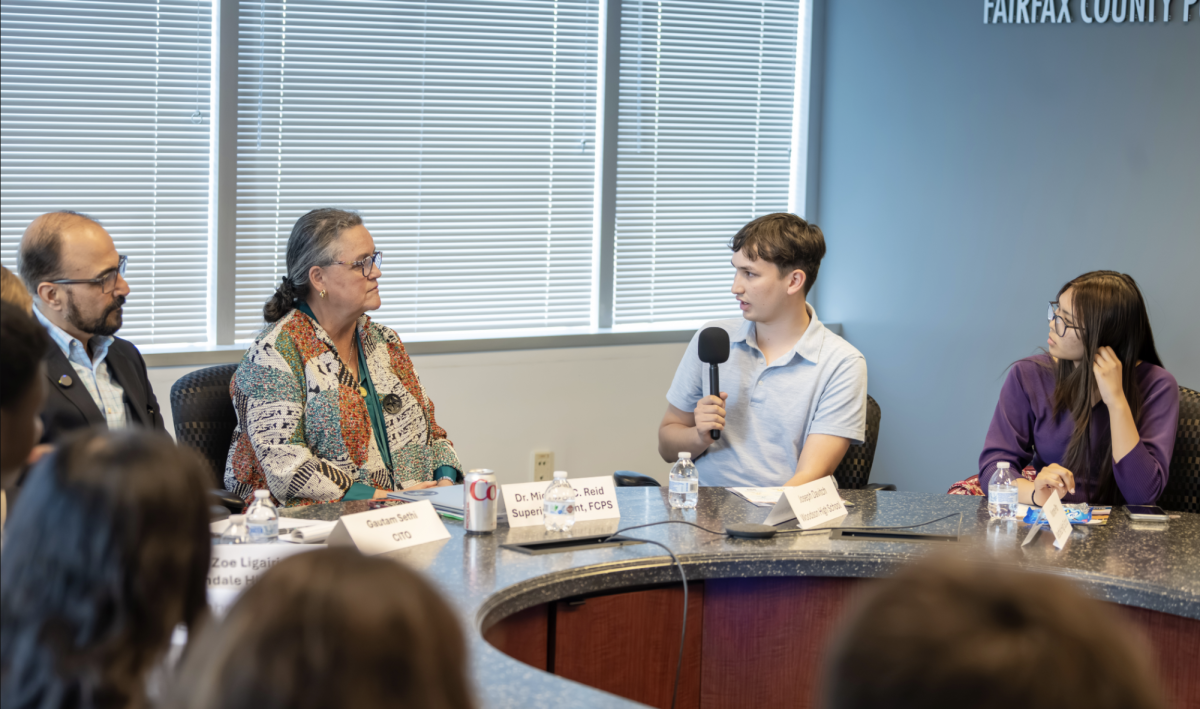
On April 30, Superintendent Michelle Reid and Chief Information Technology Officer Gautam Sethi hosted a student journalist panel on the use of artificial intelligence (AI) in education. The event featured one nominee from each high school journalism program across the FCPS participating in a Q&A session.
In December 2025, FCPS joined the ChatGPT for Teachers pilot program, encouraging teachers to incorporate the strategic and ethical use of AI into their teaching practices. While this opened new opportunities for educators to operate classrooms, students like Gisselle Tedla from The Oracle—West Springfield High School’s journalism publication—shared growing concerns regarding its implementation.
“Teachers learn good teaching practices, but applying them with AI is a [new] learning experience that everybody has to go through. Having [access to those] tools starts that journey,” Sethi said in his response. “Along the way, [FCPS is simultaneously] developing professional development [opportunities and] policies that will shape what the future looks like.”
While AI can leave uncertainties in learning environments, as Sethi’s response to Tedla’s question explained, FCPS is experimenting with new methods to implement AI rather than avoiding it.
“Sometimes, we evaluate tools by the harm that can happen instead of the good that could arise,” Reid said. “Many students have shown me [how tools like] Google NotebookLM to create quizzes, ask questions or refine presentations [can be] really productive uses of AI. I think we have to balance all of the [outcomes because] we will always find a negative.”
Throughout the discussion, the ethics of AI were inevitably brought up. Many of such questions were related to concerns about surveillance and security uncertainties.
“Training, awareness and data privacy security agreements [are all methods of how FCPS is] really putting a lot of guard rails in place to use these AI tools safely,” Reid said. “I think [by doing so,] we may find that we don’t want to use the tools, but we need to understand them well enough before we make those decisions.”
Students also asked questions related to the environmental impacts of extensive AI usage.
“Since concerns around [AI and energy-intensive data centers] will likely take years to address, how does FCPS plan to consider these concerns in the meantime, [considering] the extent to which AI [should be] used and encouraged in classrooms?” said junior Ariya Lee, news editor of the Purple Tide from Chantilly High School.
While FCPS has primarily focused on making the transition to AI in classrooms smooth over the past few months, environmental impacts have similarly remained a top issue for Reid and Sethi. Reid’s response to Lee reflected the challenge of balancing AI integration with environmental sustainability as both remain important priorities for FCPS.
“I think there is still a lot to learn [because students are] not only going to see the power of these tools, but also the impact on the environment,” Reid said. “One thing I learned from the Navajo, an indigenous tribe, is that when they make decisions, they filter what will be best for those seven generations from now. And I wonder, if we made decisions with that in mind, would we even go down this path of [AI implementation]?”
Throughout the hour-long discussion, all 27 journalists actively and successfully engaged with Reid and Sethi about an issue that could fully change the student learning experience across FCPS.