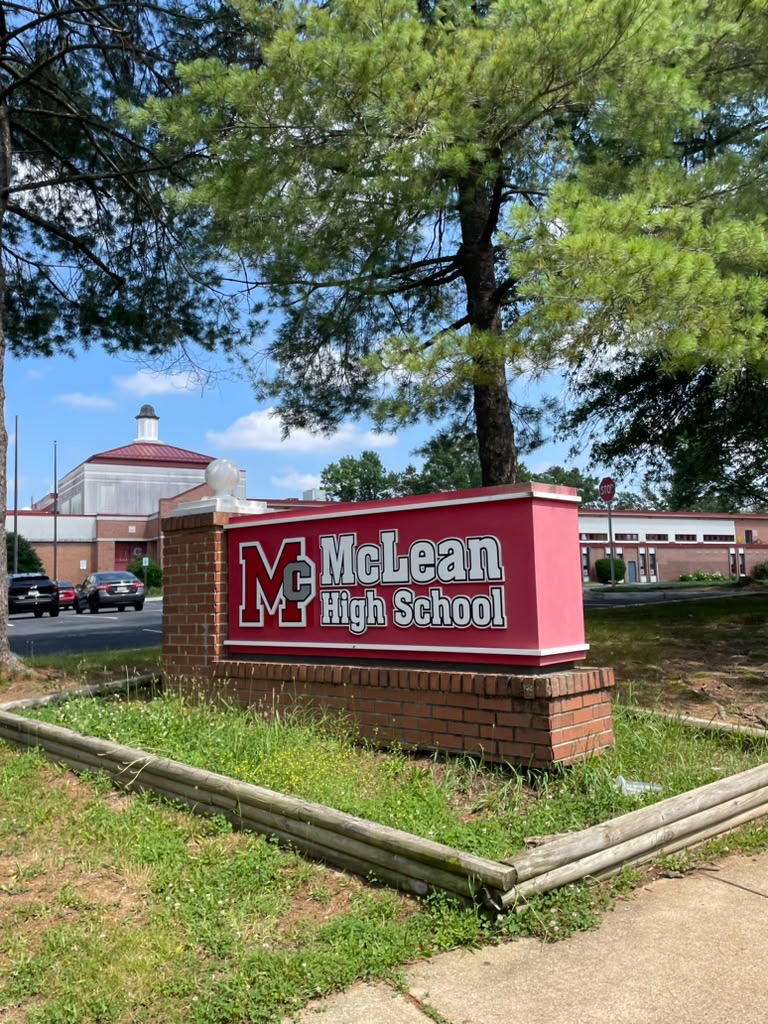





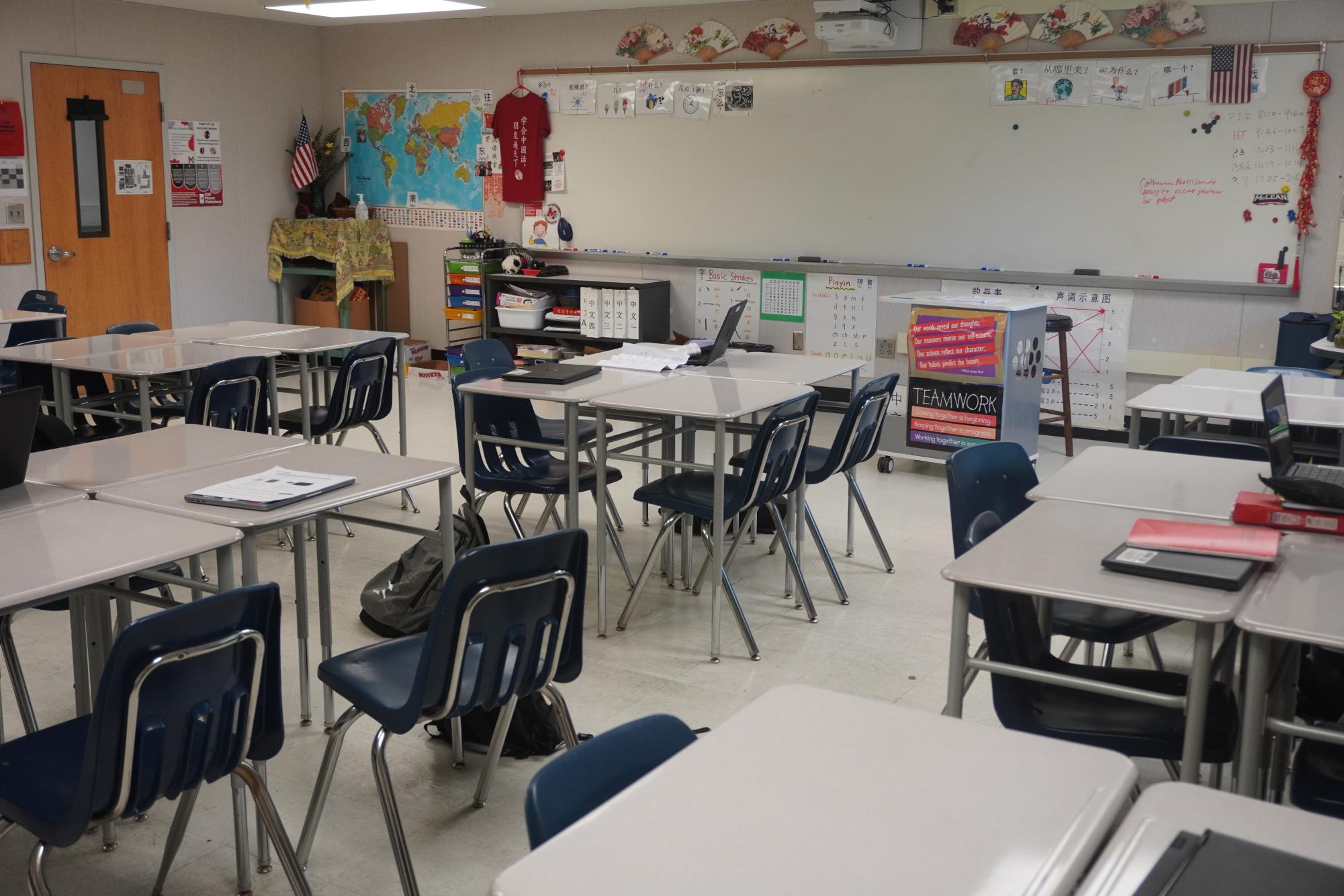
All 87 students enrolled in Chinese for the 2026-27 school year received an email in late April that Chinese classes would no longer be offered at McLean going forward. Those who wished to continue taking the language were told they could take a bus to Marshall Academy, a 15-minute drive away.
The announcement came via an email on April 23, more than one month after course selections were finalized on March 13. The late decision left students scrambling to arrange new courses.
“I’ve [opted not] to take Chinese next school year, and I’m taking another elective instead,” junior Charlotte Chien said. “I think most of my Chinese class did the same.”
Although Marshall is an alternative, many students are deterred from enrolling due to inconvenient transportation. While buses to the Academy are scheduled to leave when third period begins and return before the next period, many have experienced frequent delays with the service.
“It is such a huge time sink to go to Marshall and come back, because you always eat into another class,” senior Diego Lowe said. “I find every single class I’m taking this year and in past years to be valuable, so if you miss 10, 20, 30, even 40 minutes of class due to a transportation delay, that just doesn’t make sense.”
Students taking Chinese classes besides AP can opt to take the course online through FCPS Adult and Community Education academy (ACE), but there is concern over the efficacy of online instruction when compared to in-person teaching.
“I feel like I wouldn’t be able to learn anything, and I wouldn’t be able to learn effectively online,” sophomore Angela Li said. “I remember during the pandemic, when we were doing online school, I wasn’t able to focus.”
The McLean administration’s decision to eliminate the Chinese program was primarily driven by enrollment numbers that had fallen below the threshold required to maintain a full-time language program; only 87 students across all five levels of Chinese were signed up for the 2026-27 school year. This was also explained in Principal Raven Jones’ email on April 27 after an influx of emails regarding concerns. The Highlander requested data from Director of Student Services Jenna Jablonski on course enrollment figures. She declined to provide such information.
“In order to maintain a full-time program, you need to probably have closer to 150 students,” at-large school board member Ryan McElveen said. “It’s not necessarily economical to run a program when you don’t have enough students.”
The low enrollment has been compounded by recent FCPS boundary changes, which are projected to shift students outside of McLean’s pyramid without replacing them. While intended to address overcrowding, a smaller student body means lower enrollment across many electives, including Chinese.
“We just got through a boundary change process, and that had a lot of unintended effects,” McElveen said. “One effect was that students from Springhill Elementary, which has a Chinese program, were moved from McLean to Langley, thus strengthening Langley’s Chinese program, which is already relatively strong in comparison to McLean’s.”
McLean’s reasons for eliminating the language program may have been rooted in legitimate enrollment and funding concerns, but the decision was met with uproar from the Chinese parent community, many of whom view this move as a broader threat to Chinese students.
“The majority of the student body in these Chinese classes are Chinese Americans,” said Tian Olson, Secretary of the Virginia Asian Advisory Board, which makes appeals to the Virginia governor. “By doing that, [McLean] is almost surgically targeting Asian American students. Taking Chinese is one way for Chinese American students to connect to their heritage, and now students are stripped of that opportunity.”
The unexpected, late notice also disgruntled McLean students.
“What I find the most disrespectful was the fact that [the announcement] was so abrupt and there was no communication beforehand at all,” sophomore Jacob Xu said. “[Principal Jones] seems like a great person, but the fact that she decided not to consult students or parents or even Mrs. Pearson before she made this decision is not OK.”
Parents were informed of the news through their children and other individuals in the community rather than the initial statement, which was only sent to students taking Chinese next year.
“What really upset all parents when the notification was sent was that it was only sent to the students, not to the parents,” Olson said. “Why was a notice not sent to the parents? Can we rely on teenagers in high school to relay on every single message of what’s going on in high school to the parents? That’s just not reliable.”
Shortly after being made aware of the decision, Olson contacted Jones on behalf of Chinese parents in search of a clear explanation. She did not receive any response; Jones also declined an interview with The Highlander on this subject.
In a separate email addressed to several FCPS officers and board members including Superintendent Michelle Reid, however, Olson heard back from two school board members—Robyn Lady and Ryan McElveen.
“Hello Ms. Olson and the Virginia Asian Advisory Board members,
Thank you for sharing your concern about the movement of McLean HS Chinese language SY26-27 to Marshall HS. We are awaiting next steps from a collaboration of Instructional Services Department (ISD), Region 2, and McLean and Marshall HS. I am confident they will reach a solid yet fiscally responsible plan moving forward. This is a budgetary issue due to low class sizes for both these sections for both high schools. I understand your concern and believe that the McLean and Marshall teams will ensure all students are served by the combined class.
Thank you again for your advocacy.”
— Robyn Lady, Dranesville District School Board Member
“Based on the tone of that email, it sounds like bringing back Chinese class to high school is not a part of the plan,” Olson said. “I requested that parents be present during the next round of discussion or negotiation with the FCPS administrators on this topic. [Lady is] an elected official, and her role is representing the people of the Dranesville district. How do you know [what position you’re representing] if you don’t engage us?”
Due to this change, Chinese teacher Kuan-Chen Pearson has also lost her position at McLean. She was first informed of this development through a meeting on April 19 with Jones and Assistant Principal Zack Winfrey.
“[Principal Jones] said this was a win-win situation,” Pearson said. “They could save money going to the academy, and the academy, because of our students, could survive.”
The school’s initial email to students, sent by Jablonski, cited only “program and staffing constraints” as the reason Chinese would no longer be offered at McLean. For many, it read as an announcement of Pearson’s retirement.
“There was a student who passed the email to me yesterday, and it just said constraints [to the] program and staff [as the reason for my leave],” Pearson said. “So everyone thinks the teacher is probably gone. All the students think I want to leave.”
Pearson did not plan to retire this year. She is now categorized by the county as “destaffed,” a term used to define teachers who have been removed from their current post but are guaranteed another position in the county. However, Pearson reports that she has been mostly navigating the transition on her own.
For the Chinese community at McLean, the loss cuts deeper than a mere scheduling inconvenience—Chinese is the only non-European language offered at the school.
“Mandarin Chinese has the most native speakers in the world,” Xu said. “The fact that we’re eliminating the only non-European language offered at the school, I think, is not OK.”
With McLean’s close proximity to Washington, D.C., many students eventually go on to serve in federal agencies. However, Chinese is considered one of the most useful languages for a government job, leaving many worried about the far-reaching impacts of dropping Chinese from the high school curriculum.
“For the students who want to serve in the [federal] arena in the future, whether in the military, diplomacy, intelligence or defense, the Chinese language is the single most important foreign language to learn,” Olson said. “In the military, if you have foreign language fluency, you get extra pay. For every other language, you only get paid the extra money if your job in the military is a linguist—except for Chinese. You’re stripping that opportunity for students in this region, and that is so short-sighted.”
Students also expressed confusion at McLean’s choice to eliminate all five levels of Chinese rather than Chinese 1 alone, which has the lowest enrollment at McLean.
“I feel like there should be enough people here to have at least a few periods,” senior Sam Cohen said. “McLean, of all places, has the highest number of Chinese heritage speaker students compared to other places in the county; it’s not even close. [Pearson] was such a good teacher, and they’re essentially forcing her out one year before she was able to retire. She’s been here for years, and she’s a great teacher with a great program.”
McLean’s choice to remove Chinese also presents challenges to those that want to earn academic credit from taking the course.
“This really throws a wrench into a lot of students’ academic plans, especially if you are already in Chinese 3 or 4 and want to complete AP Chinese, which provides a foreign language credit that can be transferred to college,” Olson said. “A lot of parents are so angry; there are several hundreds of chat messages in the [Chinese parent] chat groups every day on this topic.”
With Pearson gone, the Chinese Club and the Asian American Association—which are havens for Chinese students to celebrate their culture—will lose a key sponsor and advocate.
“She has really been a source of support for many Asian American students,” Xu said. “It’s the removal of a community.”
McLean parent Tim Zhao believes that Chinese parents must be outspoken in their beliefs to prevent unannounced changes like this in the future.
“I’ve been, so many times, the only person representing the Chinese population in the McLean Community Center [for events],” Zhao said. “We need people to be there—in the hearings, in any position—so they know what’s going to happen, and they need to hear our voices.”
Lowe echoes this sentiment, expressing that his frustration comes not from the actual decision, but rather the absence of any notice or collaborative effort between administration and the community beforehand.
“The administration, from out of nowhere, imposed a sentence without telling any of us,” Lowe said. “If we had collaborated beforehand, it would have been a lot easier. The whole takeaway from this situation is collaboration. Because ultimately, it’s the students that get affected first.”
Negotiations between McLean, Marshall, FCPS central office, and the community are still ongoing. After a meeting with Jones on Monday, April 27, board members are working to coordinate a follow-up meeting with families.
“I don’t think anyone is necessarily going to get what they want,” McElveen said. “But we’re trying to find a way to have in-person instruction in both schools.”
Several families have reached out to neighboring schools, including Langley, and many have begun contacting the school board in solidarity. A petition circulated among the families has also drawn over 130 signatures.
“When somebody makes a decision on this level, it is really hard to turn it around,” Zhao said. “You have to fight before this happens.”