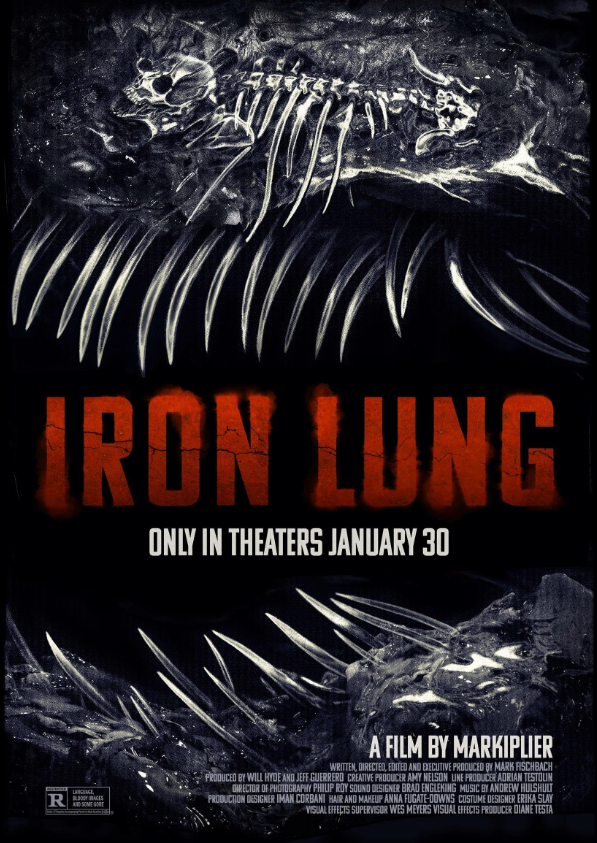
Debuting a fresh perspective on big screen sci-fi horror, Iron Lung is more than just another indie passion project. Adapted from the 2022 cult indie game of the same name by David Szymanski, the entirely self-financed film–written, directed and starred by “Let’s Play” YouTube legend Mark “Markiplier” Fischback–released Jan. 30 captivated fans with its gripping ode to existentialism and immersive claustrophobia.
The film quickly gained box office success, drawing a staggering $18.19 million on its opening weekend compared to its $3 million budget, defying both industry expectations and norms. This feat ranked second domestically, placing the self-distributed film between releases from Walt Disney Studios Motion Pictures and Amazon MGM Studios.
Set in a post-apocalyptic far future, the story follows an event known as “The Quiet Rapture,” which severs contact between all of humanity and causes all star systems and habitable planets to vanish, diminishing the human population to only those scattered among isolated space stations. The entirety of the film centers around the perspective of Simon, a convict sent by survivors to pilot the SM-13 submarine, nicknamed the “Iron Lung,” through an ocean of blood on the desolate moon, AT-5, to explore and scavenge in exchange for freedom.
Cramped in the dark, welded shut deathtrap, he must complete the task of photographing the ocean with no sight outside of a shoddy camera. Simon is ill-informed, his only form of limited communication being a radio, forced to uncover truths while stumbling through his assignment.
As both Markiplier’s directorial and actor debut, some of his choices regarding the plot and his performance can struggle in fully hooking in the viewer as an amateur, but the film remains exceptionally impressive considering his limited experience and budget.
Being an established online personality, Markiplier’s presence as the protagonist risks obstructing the immersive world and character building necessary to captivate viewers and elicit suspense in horror. While this could affect the experience of some, the increasing atmosphere of dread and numerous compelling acting performances succeed in portraying Simon as a character detached and distinct from himself.
The film’s slow burn pacing stays true to the source material, however withdraws many viewers due to the resulting two-hour runtime. Adding to that, it’s placed in a single-setting which makes it tricky to maintain engagement through purely script over the full length of the film. Time is deliberately used to cultivate dread and desperation as Simon’s state deteriorates in his confinement, though this can sometimes feel dragged on. This contributes to a slow, low-energy beginning which ultimately builds momentum towards a satisfying and emotional end.
Not just the pacing, but the entire movie directly corresponds with the game, David Szymanski deeply involved in the creation of the film. The film stuns visually with its dark and moody cinematography, set design, and styling. This aspect is also supported by the phenomenal score as sound, or lack thereof, is used extensively to build atmosphere.
Despite some critiques, the film succeeds as an ambitious debut film that enthusiasts of both the game and Markiplier are likely to enjoy. As an indie, self-produced film, achieving such a great level of success revolutionizes the expectations of top box office films and foresees a new era of Hollywood.