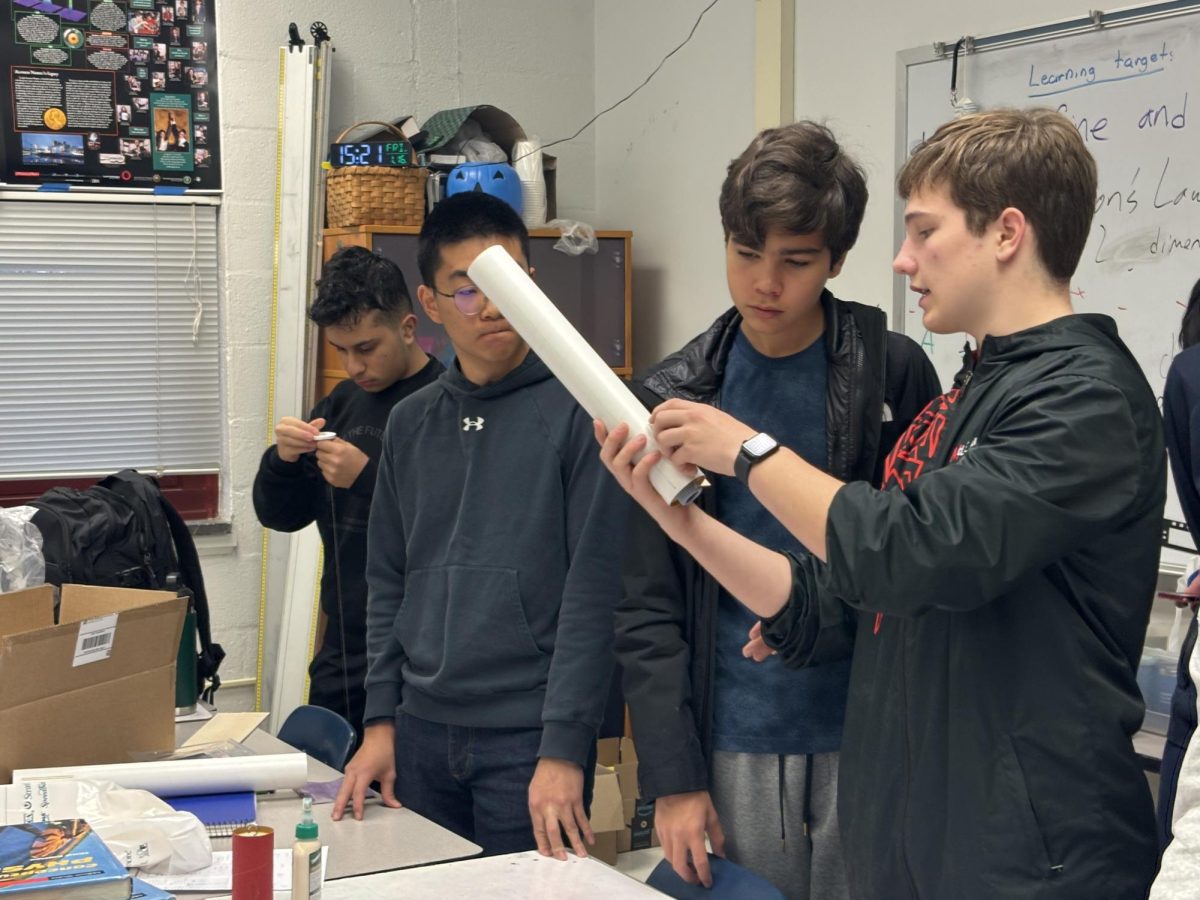
McLean’s Rocketry Club is racing against the clock to finish building its first competition rocket by February. Team members are spending their Friday afternoons carefully constructing a functioning model rocket for McLean’s debut in the American Rocketry Challenge.
“We are divided into two groups,” club president Eunice Sim said. “Some people are working on gluing the fence down, and others are working on the payload section.”
The club, in its inaugural year, must submit qualification flight data by March 31 for the American Rocketry Challenge. Only the top 100 teams out of 1,000 will advance to nationals in May, and the top 10 nationally will earn a spot at the NASA student launch in Huntsville, Alabama, home of NASA’s Marshall Space Flight Center.
“Our goal is to [advance to nationals],” Sim said. “We don’t know if we will make it or not, because we haven’t done any flight tests yet. But if we do get more data, we will probably get a good sense of where we are right now.”
Steve Morris, the club’s National Rocketry Association (NRA) mentor, is guiding the team through the challenges of their first build. Morris was hired through the NRA mentor program, which pairs instructors with experience in engineering with high school teams. Morris helps the team with propulsion and recovery systems while also teaching general engineering lessons.
“Rocketry is complicated,” Morris said. “If you have a team of eight people, you can use different people in different ways, so that you have a diverse collection of skills that all come together.”
McLean’s team consisted of 20 members. In order to fund the project, the team raised around $600 through membership dues. The funds were used to purchase materials for a rocket that must follow exact launch requirements; the rocket must achieve a 750-foot altitude with a return time of 36-39 seconds.
Sophomore Everett Munson initially designed the rocket using OpenRocket software, refining his own design over six iterations before reaching the final model. He competed against four other students to determine the final design.
“There was only one [of my] iterations that hit the requirements, one that allowed for variance in height and one that allowed for the materials we currently have,” Munson said.
The current design is 92 inches and uses a constant 2.2 inch diameter for the body of the rocket to remain aerodynamic.
“Ideally, we would have to overshoot the goal by about 100 feet, just to account for wind and things not exactly being where they are,” Munson said.
After the design was completed, the building process started almost immediately. The team split up into two groups, each focusing on different parts of the rocket.
“We use wood for the fins, cardboard for the body and nylon for the parachute because it is the most durable,” team member and sophomore Inhee Do said.
Using X-Acto knives and sandpapers, the builders measure each part of the rocket precisely to fit exact specifications. Even minor errors could compromise the rocket’s performance.
“One mistake, and there is a gap in the tube, meaning the aerodynamics fail and the rocket goes straight into the ground,” Do said.
Motor selection has been the largest challenge for the team.
“The motors are very scarce,” Munson said. “The biggest challenge I probably had was finding the right motor, because one of them can barely hit 750 [feet] and the other is sending me well into 1,000.”
Despite challenges, the team is progressing well and plans to launch in the following weeks.
“This is a first-year team, so there are first-year learning curves associated with anything,” Morris said. “They’re in fine shape.”
The club plans test flights at Great Meadow Field in rural Virginia early February. Monthly launch windows create tight deadlines, which are made worse by slow supply delivery.
“The launches only happen once a month, and we need to get our rockets ready before then,” Sim said. “Purchasing the supplies already took us a long time.”
Success for the team is defined by not only reaching nationals, but also executing a safe and functional launch with minimal errors.
“Launch fever is a thing,” Morris said. “Usually, good outcomes don’t happen when you rush yourself into complicated things like this.”
For Morris, a successful first flight means more than just competition rankings.
“They’re making stuff with their own hands. It’s going to go from zero to 250 miles per hour in two seconds,” Morris said. “For a first year team, having a successful flight, a safe flight where the parachute comes out, the egg isn’t broken, it goes straight up like it should—that’s success.”
Beyond this season, Sim is already planning for the club’s future. She hopes that the team’s underclassmen will build on this year’s experience for future competitions.
“The seniors are going to graduate and go on to awesome things,” Sim said. “And the freshmen and the juniors and the sophomores will learn from this year’s experience and then carry forward and be that much further up the learning curve next year.”