
Following the Democratic Party’s wins across Virginia on Nov. 4, education reform has emerged as a high-profile issue that is already gaining national attention before Governor-elect Abigail Spanberger even takes office.
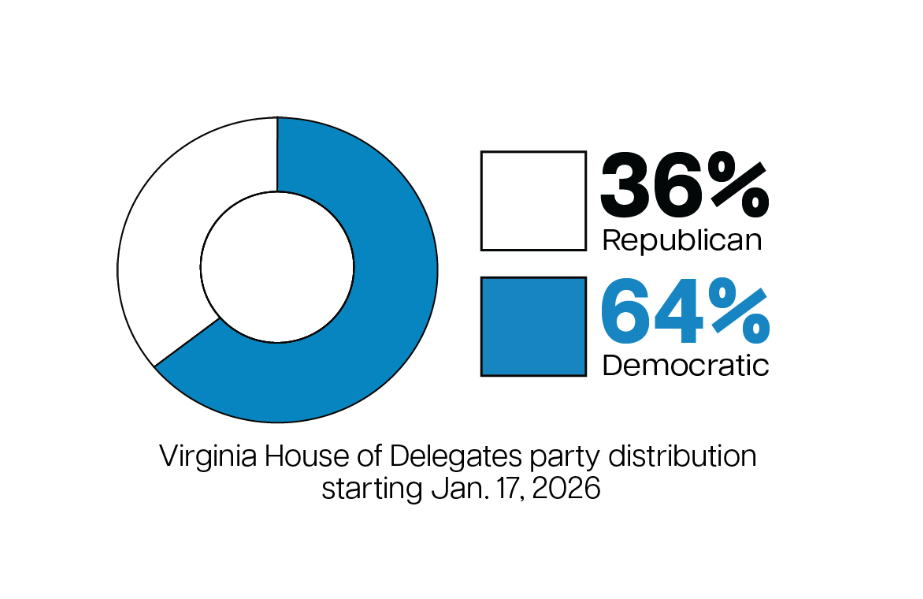
Democrats swept the 2025 elections, winning the races for governor, lieutenant governor, attorney general and 13 more Democrat-controlled seats in the Virginia House of Delegates.
“It was a great night for Democrats,” said Jack Stanley, a project manager for Pocket Aces, a Democratic consulting firm in Northern Virginia. “It was not surprising that they gained a lot of seats in the House. The win was a little bit larger than even some of their most aggressive projections. It speaks to the anger that voters are feeling about the Trump administration right now.”
With this major party shift, the amount of funding distributed to public schools is expected to increase.
“For years now, Democrats have been fighting for increased education funding from the state,” Stanley said. “It’s something that Virginia has historically not done well. Now, there’s more support in the House [to get more funding], and we have a governor that is more interested in signing legislation that does so.”
The incoming Democratic legislators claim to be committed to improving the public school system. “The Democrats’ top priority is creating new funding sources to be able to fully fund schools and keep up with what the needs are today,” said Ben Tribbett, the founder of Pocket Aces. “In Fairfax County there’s a lot of investments that need to be made.”
One way the Democrats are going to put more money into public schools is by cutting back on school vouchers. Vouchers are given to parents to pay for private school tuition. This is money that was originally allocated to public schools but taken away in order to afford these vouchers.
“Democrats do not believe in vouchers for families to take and help support private school education,” school board member Robyn Lady said. “If you look at the states that have vouchers, their public school systems are incredibly weak. Gov. [Glenn] Youngkin [supported] taking money allocated to public education [to put into vouchers].”
Some bills that failed to pass under Youngkin could be reintroduced now that the Democrats have gained more power in Virginia. Among these bills is HB2341, which Youngkin vetoed in March 2025. It would require the Virginia Department of Education to develop and instate “culturally responsive and language-appropriate mental health support and services” in schools.
According to Youngkin’s official veto statement, this bill was shut down because it could “conflict with federal orders,” specifically the orders to restrict funding for diversity, equity and inclusion (DEI) initiatives.
“FCPS is one of the most culturally diverse school districts in the nation, where the student population is made of students from hundreds of different nationalities and cultures,” senior Daanial Pasha said. “Support services for students at McLean might not be as inclusive as they can be at their maximum potential, and it is highly likely that there are many students who desire such services but don’t have [access to them].” If HB2341 passes, schools will have the ability to choose how they employ these services as long as they comply with state guidelines.
“In the last decade, we have seen increasing levels of mental health challenges in our young people,” Virginia State Sen. Stella Pekarsky said. “In the Commonwealth, there are very diverse populations, and that means that the way we support and how we try to understand those challenges has to be from a lens of cultural understanding.”
Another bill that may be reintroduced is HB1824, which would allow students to take African American Studies in place of another history course like World History; the bill was vetoed by Youngkin in May 2025.
“A thorough, sequential study of world history is critical to preparing students for informed citizenship and global awareness,” Youngkin said in his official veto statement.
“Substituting World History I or World Geography would cause students to miss key concepts essential to understanding how historical world events have shaped our modern economy, government and international relations.”
Some Democrats assert that the newly elected administration will make different decisions regarding controversial curriculum.
“[Youngkin] tried to remove all discussions in schools away from race. So much of Virginia and its history has to do with race,” Tribbett said. “[Republicans] try to make it seem like it’s this ancient history. For Virginia, a lot of this stuff is much more recent.”
Already impacting education before she takes office in January, Spanberger requested that the University of Virginia (UVA) pause its search for a new president until she is sworn in. The search is being conducted by UVA’s Board of Visitors, whose 12 voting members were appointed by Youngkin. Currently, there are five vacant seats on the board because the Virginia General Assembly rejected eight of Youngkin’s appointees.
“Since we had [Department of Justice] investigations and Trump had requested changes in curriculum, grading scale, international student population and research in the compact that he wanted us to sign, it’s assumed that a president selected by the current Board of Visitors would align more with those values and crack down on any sort of DEI or any sort of classes that endorse ‘liberal’ or ‘leftist’ values,” said Ashna Khianey, a sophomore at UVA. “UVA is a place where many of our classes talk about race, politics or things that could be considered unfit by this new president’s standards.”
Since the Trump administration is trying to dismantle the Department of Education, Democratic politicians believe their advocacy is needed now more than ever.
“The Trump administration is trying to…return education to the states,” Tribbett said. “That makes whoever is in charge of education policy in the states even more important because there’s not going to be these federal guards against what’s taught in the schools or what type of things are required.”
Republicans will face a harder time challenging the Democrats’ decisions.
“The Republicans will certainly push back, but they don’t have the power to,” Tribbett said. “They’re not going to be able to stop anything. But, they have 36 [delegates] who will be able to speak on the floor.”
Some Virginia residents believe that nothing in education will change significantly based on who is in charge. Governors in Virginia are term-limited, which means they can only serve once for four years.
“As far as in-classroom work goes, the changes that hit public school often take more than four years,” social studies teacher Ian Howell said. “It takes years to get these ideas rolling. With a four-year term, and then with the shorter terms at the state level, you just can’t transform it.”
Still, Spanberger’s policies will have the potential to shape the future of Virginia.
“There’s going to be a lot of conflicting needs, including healthcare access and benefits,” Pekarsky said. “But, education remains [important], and finding new revenue streams is a priority for us so that we can reinvest in our schools.”