

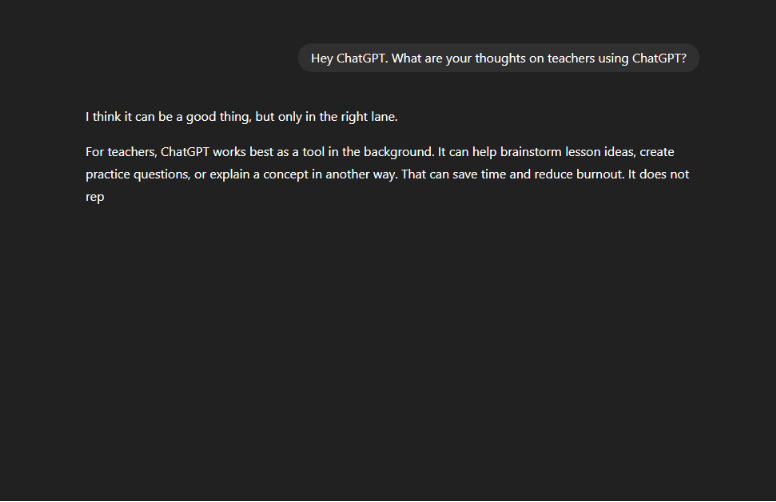
Starting next school year, FCPS will be one of the first 16 school districts nationwide partnering with OpenAI to give teachers free access to ChatGPT for Teachers: a version of ChatGPT designed especially for K-12 staff.
The platform, which includes premium features normally reserved for paid users, will be available to FCPS employees at no cost through June 2027. The tool is designed to assist with lesson planning, curriculum design, communication and instructional preparation.
Artificial intelligence software is already used by many teachers for support, but the partnership marks the first time FCPS has formally encouraged a specific AI platform for staff use.
In a message, Superintendent Michelle Reid described the rollout as “this generation’s ‘Sputnik moment’” for education, “trailblazing a path for hundreds of other school divisions and communities to follow.” FCPS and neighboring Prince William County Schools are the only districts in the Washington D.C. region to be selected for the pilot program.
For students, access to most generative AI tools on school-issued devices will remain blocked.
Despite this upgrade, AI tools are already common in FCPS classrooms. For chemistry teacher Eriny Youssef, AI has become essential for managing her workload. When short on time, she uploads lesson slides to Google Gemini and asks it to generate student-friendly notes or simplify advanced materials.
“If I don’t have time to make notes or practice for my students, I’ll ask them to turn my PowerPoint into detailed material,” Youssef said. “Or I’ll have it take something that’s college-level and make it appropriate for honors or regular classes.”
She also uses AI to rewrite textbook questions she can’t copy digitally, saving hours of manually typing.
“It still takes time,” Youssef said. “But not as long as if I were typing fifty questions myself.”
Administrative tasks, which include writing emails and drafting paperwork, have also been simplified with AI use.
“Sometimes, I’ll put in a few sentences I’ve already written and see how it phrases [the emails],” guidance counselor Kathleen Otal said. “It just helps make things clearer.”
Still, teachers emphasize that AI-generated learning content requires extensive human correction in order to be accurate.
“I use [AI tools] sometimes to generate examples or quick practice materials,” English teacher Tatiana Le said. “But most of the time, what students see looks nothing like what the AI first produced.”
This reality contradicts the time-saving narrative often pushed by companies hoping to adopt AI in schools. In fact, the effort required to polish generated work may take more time than creating materials from scratch.
“A lot of the time, it takes more effort to quality-check and revise what AI gives you than it would to just make it yourself,” Le said. “You have to be there the whole time. You can’t just take what it gives you.”
Otal believes the same caution should apply to every-day tasks.
“I think it can help in small ways,” Otal said. “But once you start depending on it too much, it stops being useful, because you have to realize that correcting what it produces can take longer than just doing it yourself.”
While teachers may use AI to help create classwork, using the tool for grading holds strong teacher opposition. In a Gallup poll, 60 percent of teachers report using AI tools in their work, but only 15 percent rely on them for grading.
“Using AI for grading, I don’t think that’s a good idea,” Youssef said. “Teachers bring empathy when they read student work. That’s something AI doesn’t have.”
Students share similar concerns about the use of AI for grading.
“For anything that actually affects a student’s grade, a human should be responsible for that,” senior Sam Cohen said.
Cohen supports AI use for clerical or organizational tasks, but worries that expanding AI in classrooms could reduce connections between teachers and students.
“If AI is writing lessons and grading assignments, it takes away the human part of teaching,” Cohen said.
As the implementation of ChatGPT for Teachers approaches, many educators are careful to make any initial evaluations.
“I’m not too excited about it now,” Otal said. “If I learn more about it, I might be. I can’t exactly think how those pro features are going to be used for me.”
Overreliance on AI technologies is a point of concern for many, especially considering its environmental impact. According to Cornell University, AI is set to annually emit 44 million metric tons of carbon dioxide by 2030, the equivalent of 10 million cars.
“I worry that people won’t think for themselves as much,” Otal said. “AI takes a lot of energy to run, and it’s being pushed upon teachers in ways that assume everyone wants to use it.”
There are also worries that AI adoption could become a quick solution to problems that require more effort to investigate.
“There’s a lot of pressure on teachers right now,” Le said. “My worry is that AI becomes the supposed ‘solution’ instead of addressing class sizes, workloads and expectations.”
Le described how technology tools framed as time-savers could give schools a reason to demand more work from educators.
“Oftentimes tech tools get used as a band-aid for larger issues,” Le said. “[They’ll say], ‘it’s okay that you have a class of 35 this year, because you can just use AI to make their assignments and it’ll save you time.’ It becomes an excuse to make education worse in all other respects.”
Without proper training, new AI tools may also be misinterpreted as infallible by educators.
“While some teachers have been experimenting with AI tools for years, others—especially those less familiar with the new technology—may view the software as more revolutionary than it actually is,” Le said. “Many teachers who aren’t tech-savvy may look at AI as a magical fix, but if you don’t understand its limits, that’s where mistakes can happen.”
Additionally, across the country, access and training can vary widely between schools and districts.
“Not every county can afford premium licenses or the time to train staff,” Le said. “And even within a district, teachers will have different levels of experience.”
Students, meanwhile, express mixed reactions to the partnership, especially because teachers receive expanded access to AI while student use remains restricted.
“If you’re really following the rules as a student, you’re not supposed to touch AI at all,” sophomore Tarek Elbehiry said. “But teachers are being encouraged to use it. That really feels unbalanced.”
Elbehiry says he uses AI at home to study and create flashcards, activities that could enhance his learning if used with proper supervision during school hours.
“Having AI as a tool that we use to help us either study or come up with ideas shouldn’t be limited to just teachers,” Elbehiry said.
Despite formalizing AI access, FCPS has not presented a comprehensive AI policy for adoption. The 16 pilot districts will determine whether ChatGPT for Teachers becomes an effective support tool for teachers or another responsibility for already overloaded educators. For teachers, the path forward is uncertain.
“A lot of us are just experimenting,” Le said. “We’re still figuring out what these tools can actually do, and what they can’t.”