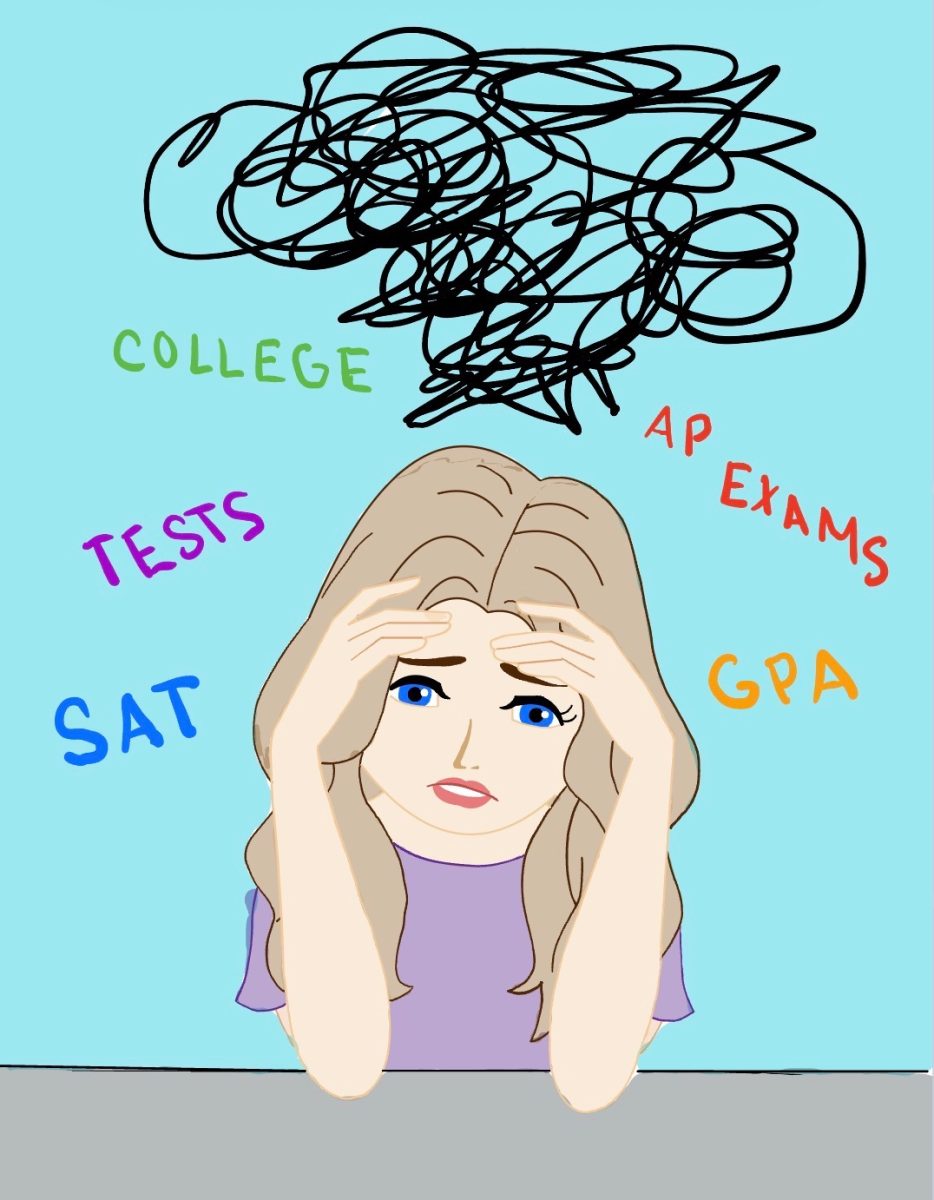

Contrary to common belief, naps are not just for children or the elderly. They are needed by a population that suffers from severe sleep deprivation and stress: high schoolers.
Although a rather simple solution to a large problem, designated nap times for high schoolers are a small step towards an end goal of protecting society’s most vulnerable, the youth.
Every day, teenagers struggle to keep heavy eyelids from closing, desperately attempting to understand the words coming from the teacher’s mouth and leaving class feeling even worse than before.
Working late on assignments leads to drowsiness during school, which forces students to learn the material independently, causing them to go to sleep late once again. This is the perpetual cycle that high schoolers are faced with.
It’s glaringly obvious: sleep deprivation is becoming an epidemic in high school students.
The numbers prove its significance. According to the CDC, in 2025, seven in ten high school students suffered from sleep deprivation, with sleep deprivation being categorized as getting less than eight to ten hours of sleep every day.
This lack of sleep destroys students’ mental and physical health, wearing them out even further and creating an inescapable cycle.
Ruthann Richter from Stanford Medicine finds that sleep deprivation often hinders concentration, leading to poor grades, drowsy-driving incidents, anxiety, depression, thoughts of suicide and even suicide attempts.
That is why it is no surprise to find that sleep deprivation coupled with the pressure to perform well in school has caused suicide to be the second leading cause of death for teens in the US.
Although seemingly trivial, implementing designated nap times can be a solution to several problems faced by high schoolers. In fact, it has been proven that naps can help improve not only sleep deprivation but also cognitive skills, helping them learn better in the classroom. Short naps can alleviate grogginess, which improves awareness, boosts memory and focus and improves learning retention.
Schools have the obligation to teach their students life-long lessons. One of those lessons should be the importance of physical and mental health.
The most likely reason why designated nap times have not been put in place is because of the belief that naps take away precious instructional time. Although this is true to some extent, naps are actually most effective in short amounts.
According to John Hopkins Medicine, taking just a 20-40 minute nap is the best for restoration of attention and avoid feeling groggy. If schools were to just take out five to ten minutes from each class, they could easily make a designated nap time with minimal loss to instructional time.
At the end of the day, even if some instructional time is lost, the life lessons and the health of students should be of the utmost priority. The lessons in the classroom may be lost in 20 years, but the effects of sleep deprivation are forever permanent.
After all, maybe what students really need to wake up in class is the opportunity to finally shut their eyes.