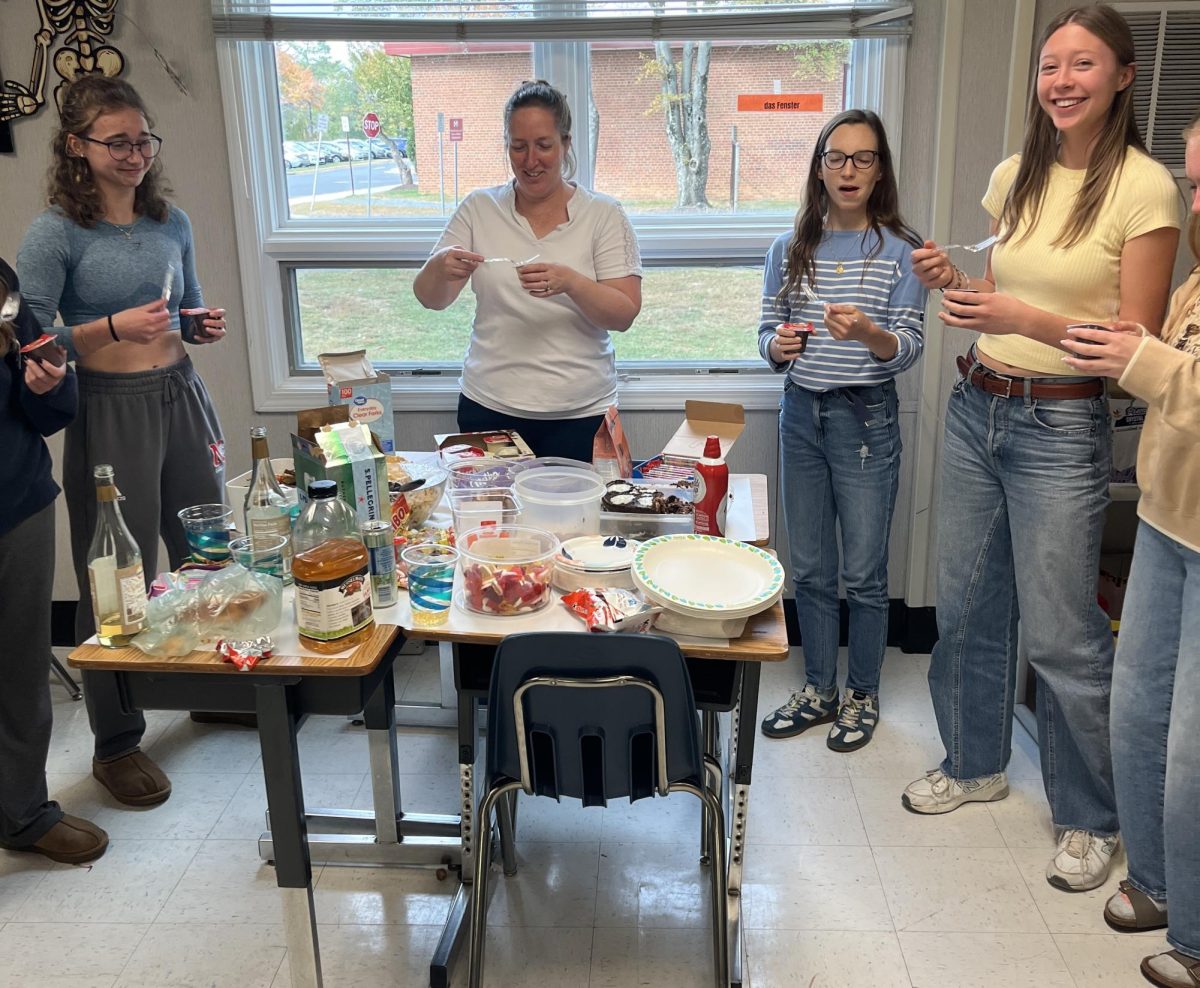
The German Club hosted its first ever Oktoberfest celebration last week. During the event, members got together after school to plan and partake in a smaller-scale version of the annual German festival Oktoberfest in order to replicate a core part of German culture.
“Oktoberfest is a huge German tradition about getting together, having fun, enjoying food and enjoying each other’s company,” said Melissa Rife, sponsor of the German Club. “The first [Oktoberfest] was actually a giant wedding reception for a prince and a princess that the king threw for everybody.”
Oktoberfest originated in 1810, when Crown Prince Ludwig and Princess Theresse had their wedding ceremony in Munich—a grand celebration of music, food, beer and entertainment. Ever since this wedding, Munich has celebrated Oktoberfest every year, with the exception of a few years due to COVID-19 and wars, from mid-September to early October.
“This is the first year that we’ve really started doing a lot of [events and activities] as a German club, so [Oktoberfest] felt like a good thing to do early on in the year to get the ball rolling,” said senior Madeleine Van Valkenburg, secretary chair of the German Club.
To start the celebration with high energy, the club decided to share various traditional German foods. While these included the most beloved German foods like pretzels and Harrisbo gummies, other foods were also featured, such as Spätzle, a dish with cheese noodles and onions, among others.
“I made a black forest cake, which is a Schwarzwald cake, and it has chocolate with cherries,” Van Valkenburg said.
After enjoying the savory and sweet food, members played Steinholt, a traditional Oktoberfest game.
“The Stein is the big mug that you drink out of when you go to Oktoberfest. It holds about a liter of liquid, and the challenge is to hold it up with your arms straight as long as possible,” Rife said. “I think the most somebody did it for [in our club] is 2 minutes, 22 seconds, but it’s just kind of fun and competitive [game].”
Later on, members learned a popular German part dance called XXX, which involves group dancing.
“[Oktoberfest allows] us to learn what activities Germans do during big events and during the trivia, and we get to learn some new facts about German [culture and daily life],” said senior Madeleine Labouche, a member of the German Club.
The intent of the German Club’s celebration was to recreate the traditional activities of Oktoberfest so members would be able to experience the festival without actually having to be in Germany. It was also an opportunity for all the members of the German Club to meet each other and have some fun.
“[Oktoberfest] is more about the culture of it and taking part in soc v.mething that Germans also take part in,” Rife said. “It is [a huge] part of the Bavarian culture—enjoying other people’s company and being together”