FCPS has begun sending parents a new kind of email—one that lists exactly what students do online during the school day.
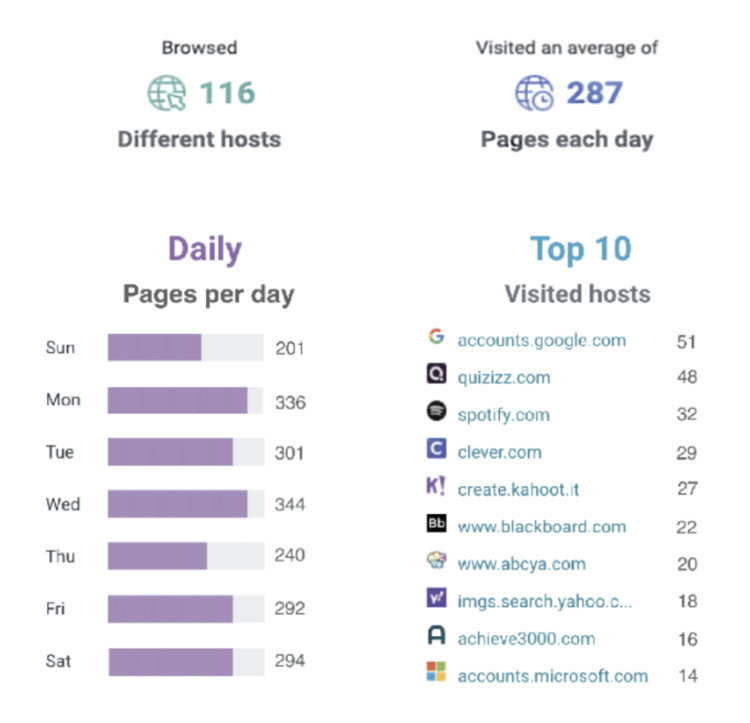
Starting Oct. 12, FCPS activated Lightspeed Student Online Activity Reports, a weekly system that emails families a summary of their child’s internet use on FCPS-issued laptops. The email, automatically sent each Sunday under the subject line “Filter Portal Weekly Report,” includes the number of pages visited, most frequently used websites and the ratio of allowed to blocked activity.
Parents can also enroll in the Lightspeed Parent Portal, which allows them to see browsing history in real time and even pause internet access on school laptops after hours. The system does not allow parents to control access during the school day, but it gives them newfound visibility that was previously only accessible to teachers and IT staff.
Some McLean teachers say the reports might reinforce better digital habits.
“I think it’s good because it gives students more responsibility when they’re on their computers,” said German teacher Melissa Rife, who has children attending Herndon High School. “It reminds them there’s a record of what they’re doing. My son told me he watches TV shows in class sometimes, and [it] was number five on his [Lightspeed] list.”
Rife first received her family’s report on Sunday and laughed at the timing.
“My kids were like, ‘Now [the school is] watching everything,’” Rife said. “But technically, it’s the school’s laptop. They have that right.”
Still, she doubts the feature will make a major difference.
“A lot of parents will see it as another school email and delete it,” Rife said. “I really don’t think it’ll have a huge impact.”
Physics teacher Jeff Brocketti called Lightspeed a logical extension of school accountability.
“You’re using a public [district] network, so you’re not owed privacy,” Brocketti said. “If you don’t want to be tracked, use your phone hotspot.”
Brocketti said that with FCPS eliminating Scantron machines and moving tests online, electronic monitoring has become unavoidable.
“You either grade by hand or go digital,” Brocketti said. “It’s foolish not to adapt, especially when AP exams are already online.”
Students, meanwhile, gave sharp skepticism about the new oversight.
“This is the type of surveillance we’re reading about in 1984 by George Orwell,” sophomore Kahveh Sabahi said. “It’s an invasion of privacy. What are parents even checking? They’re all at work.”
Sabahi thinks the feature might expose off-task behavior but wouldn’t solve the root issue.
“It’s just going to make people angry,” Sabahi said. “They’ll see YouTube and Spotify on everyone’s list. It’ll show the problem, not fix it.”
Sabahi added that even if FCPS intends the tool for safety, its presentation risks misunderstanding.
“You can click on one random site, and it might look like you’re wasting time,” Sabahi said. “It doesn’t tell the full story of what you’re actually doing in class.”
“I don’t think there should be a Lightspeed report at all,” senior Yared Million said. “It violates student privacy, and parents don’t need a ‘top-ten websites’ list– it’s irrelevant to education and more of a distraction than a tool that helps students learn.”
Some students also predict it could shift trust at home.
“If a parent sees something they don’t like, that’s what is going to create conflict,” Sabahi said. “Instead of teachers helping students refocus, it’s going to turn into parents policing them instead.”
According to FCPS, a limited version of the Lightspeed reporting feature existed last year but required parents to opt in through a counselor or technology specialist. Only a handful of high schools participated. Now, the system is district-wide and automatic. Every parent receives the weekly summary unless they unsubscribe manually.
FCPS frames the rollout as part of its digital citizenship program, which encourages responsible and ethical tech use. The district’s website emphasizes that “ensuring students learn to use technology safely, responsibility, and ethically is a shared responsibility.”
For students like Million and Sabahi, that shared responsibility feels one-sided.
“If you want us to be responsible, you also have to trust us,” Million said.
Teachers remain cautiously optimistic.
“I think most students will just keep doing what they’re already doing,” Rife said. “If it makes a few realize that their internet use matters, maybe that’s enough.”