People ages 16 and up are fully functioning members of our society, yet they cannot fully participate in our democracy. To ensure that the government fully speaks for everyone, they should be able to cast their own ballots. It is imperative that voting rights be given to 16 and 17-year-olds in Virginia for local and state elections.
Those under the age of 18 comprise nearly 25% of the U.S. population. This demographic is most affected by and outspoken about pressing issues such as education and climate change—but decisions spanning these topics lack representation from the very group they target.
By allowing young people to vote, their voices would be heard on issues close to them, instead of being suppressed.
Adults will be able to vote for Virginia’s next Governor, Attorney-General and all 100 members of Virginia’s House of Delegates on Nov. 4. Even though these elected officials could enact laws that significantly impact students, only a small percentage of them who are 18 or older will be allowed to vote.
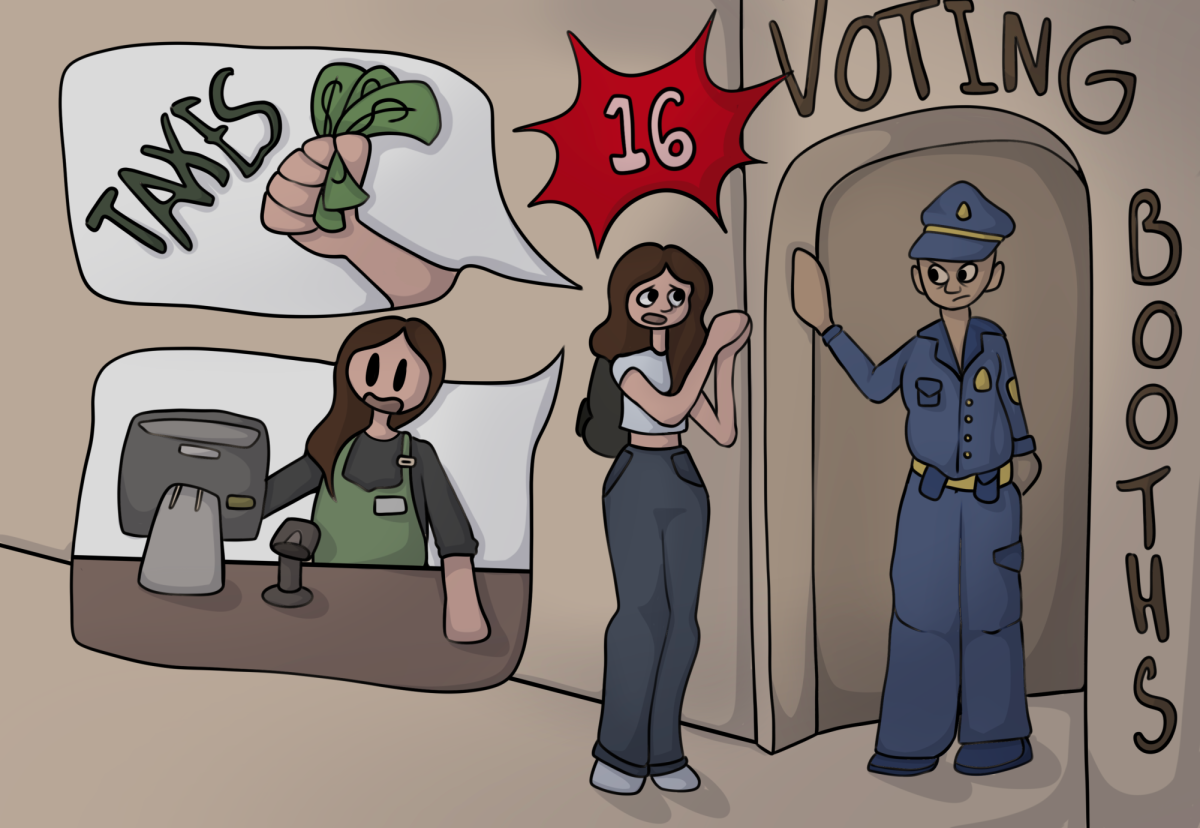
Virginia already treats 16 and 17-year-olds like adults in important ways. They can be emancipated from their parents, drive, work and pay taxes on their income.
Teenagers are also often employed, and they contribute significantly to Virginia’s economy. With almost the same responsibilities as adults, these near-adults should be able to vote in state elections.
All around the world, people under 18 are demanding the right to vote, and several countries, including Austria, Malta, Brazil and the United Kingdom, have already granted that right to people aged 16 and older.
These countries acknowledge that the voice of older teenagers matter. According to Mark Wagner, a social science professor at the University of Vienna, the quality of young people’s votes are similar to that of older voters. When younger people vote, they allow their interests to be considered equally with adults.
Young people gaining the right to vote is also happening in some parts of the U.S. Two cities in California and five cities in Maryland allow 16 and 17-year-olds to vote in local elections.
In fact, in the city Takoma Park, Maryland, those under 18 vote at higher rates than the rest of the population. Thus, Takoma Park has a higher voter turnout relative to its population compared to other U.S. cities.
A study conducted in 2012 at the College of William & Mary illustrated that voting is habitual, and like any other habit, it must be practiced for a long period of time. Allowing younger people to vote encourages beginning the habit earlier in life, which can strengthen our democracy long-term.
“We have pretty low voter turnout as it is,” social studies and government teacher Ian Howell said. “If your population has no sense of [the] efficacy [of voting], then you need to educate your population better.”
A concern about lowering the voting age is that young people are not mature enough to vote. However, according to a 2011 study in Annals of the American Academy of Political and Social Science, 16-year-olds are developmentally ready because they have similar measures of civic knowledge, political skills and tolerance compared to adults. In other words, they have the cognitive abilities to vote prudently.
“[How ready to vote they are] is relative to the education of the student, and the state of mind of the student,” Howell said. “I’m not sure that age is the end all, be all.”
Preventing teenagers from voting suppresses their voice on issues that disproportionately apply to them, such as climate change and education. Only when teenagers gain the right to vote will their voice be heard.