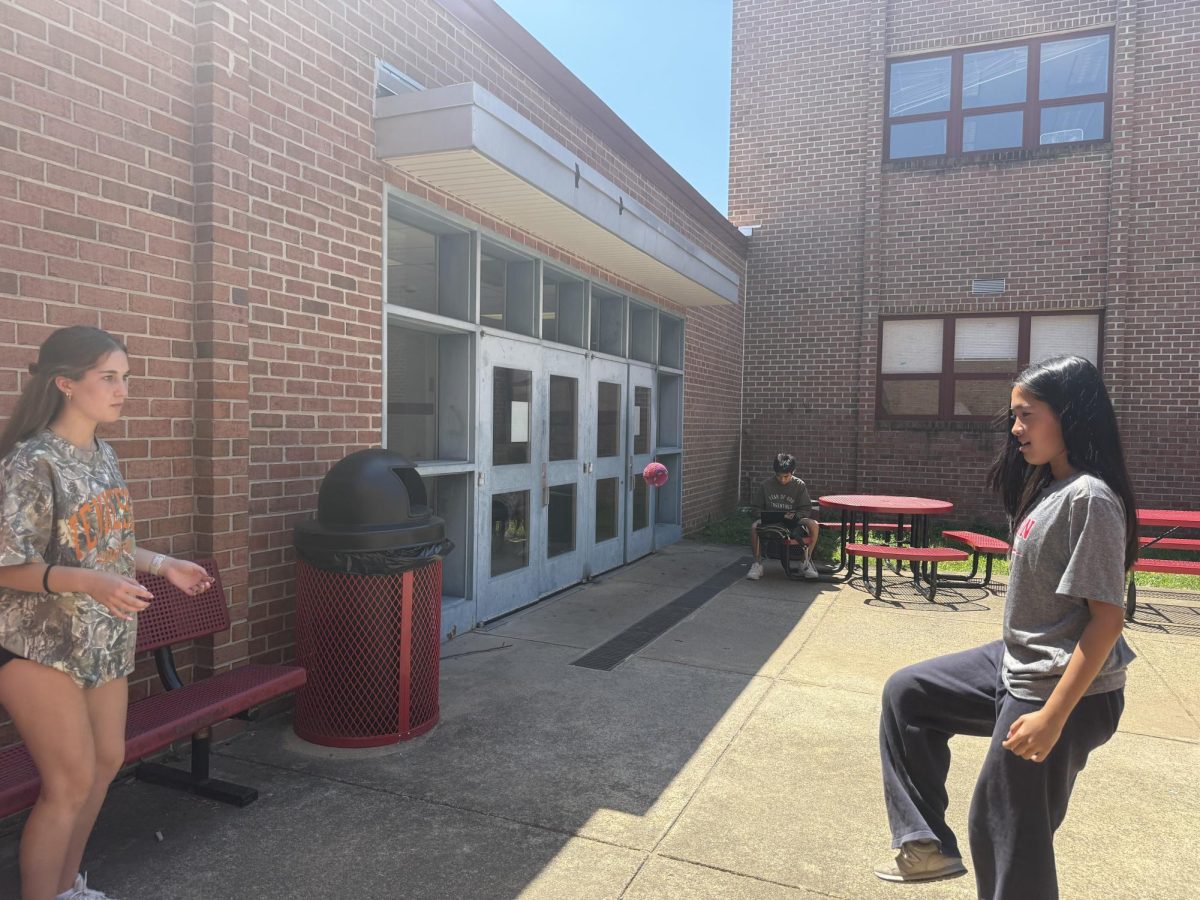
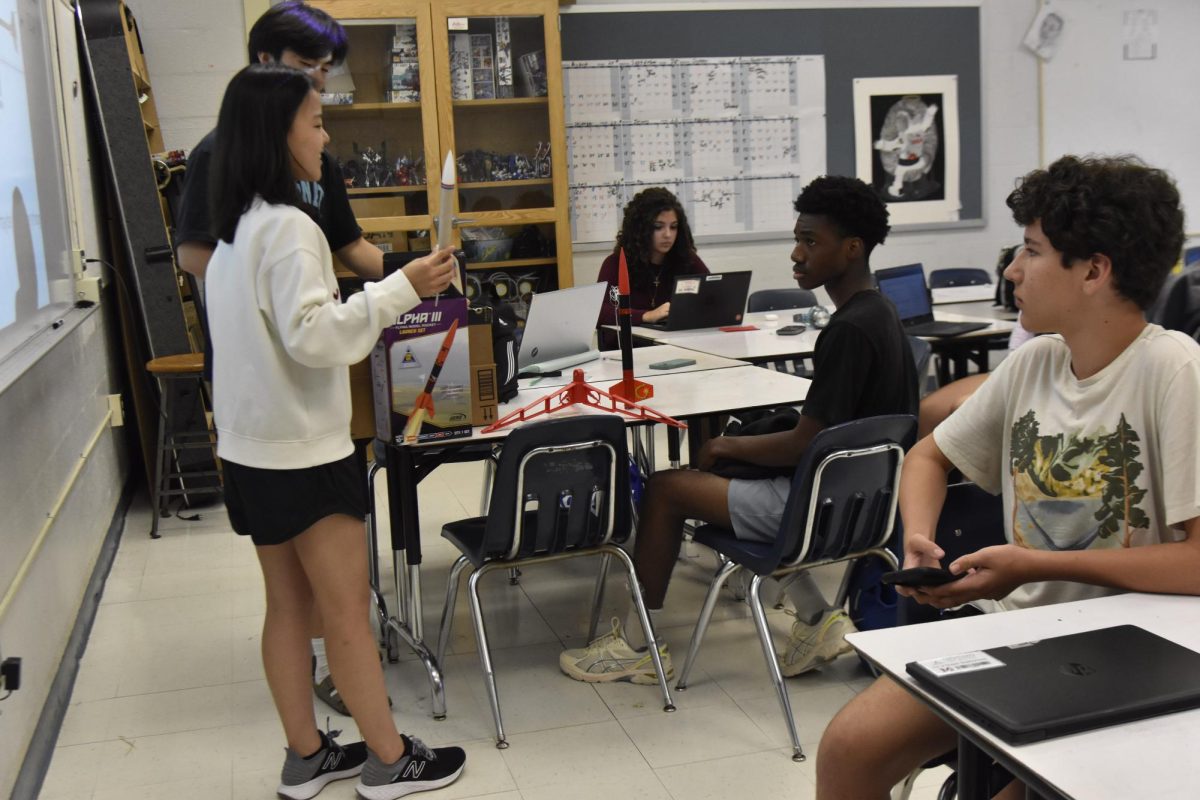
The McLean Rocketry Club is a club where students launch and design their own rockets. Members gain important skills through hands-on activities like launching and building rockets.
“I’ve learned how to communicate with other people, [such as] the teacher, the mentors and with the other students,” said sophomore Eunice Sim, founder and president of the club. “There were a lot of communication skills that I had to use and also develop and learn.”
Sim has a love for engineering, and she wanted a place outside of the classroom to foster her passion. As a result, she launched the club in February.
“I have always been interested in space and engineering since I was young,” Sim said. ”I figured out that we don’t have a [rocketry] team at school, so I thought, why don’t we make one?”
After Sim designated physics teacher Sean Jones as the sponsor, she sent paperwork for permission to start the club in October 2024. After the rocketry club was approved in February 2025, Sim and the other members embarked on a fundraising process to raise money for covering the costs of the components necessary to build a rocket.
“We don’t have anything from previous years,” Jones said. “So we can’t reuse [materials] like a lot of clubs do.”
Because this is only the club’s second year, they still have a lot of room to grow and gain momentum, a goal they hope to achieve this school year.
“We’re learning to walk right now,” Jones said. “We’ve gone past crawling, and we’re trying to figure out how to stand up and walk that awkward stage.”
Although the club tries to attract people from all grade levels, they specifically appeal to underclassmen who are passionate about physics or engineering.
“We have a lot of students who are really interested in science but don’t have a lot of ways to engage in engineering or physics until they’re older,” Jones said. “The underclassmen are really excited, but are kind of constrained by what biology and chemistry can offer.”
The main purpose of the Rocketry Club is to help students make and launch their own working rockets. The club is working toward competing in the American Rocketry Challenge, a competition in which middle and high school students compete based on specifications of the challenge that year.
“There are specific goals that we need to reach for the competition,” Sim said. “Our main goal is to give students the opportunity to go through that process of engineering.”
The launch teams are made up of at least three people. The team members work together to launch their rocket during competitions, with each person having a different, critical role in the launch.
“We would have the pilot, the engineer and the recorder,” Alicia Hoadly, former rocketry club sponsor. “The development of the team with those roles was really helpful for kids. Everybody had something that they could do.”
The club members receive regular lessons on the physics they need to know for the launches. However, the club is different from just any physics class—they apply their knowledge in hands-on situations when building and launching their rockets.
“It’s a really fun experience because it’s not just you sitting there and solving problems,” Sim said. “You’re actually building something and going out to the field to launch it.”
The launches are not all smooth sailing; parts can break or malfunction, which is an issue scientists also face in real life. However, this helps teach kids resilience and determination.
“There’s a lot of failure analysis involved in engineering and problem solving,” Hoadley said. “When you get things right from the get go, you don’t push yourself on what else you might be able to do.”
Rocketry Club members are able to gain real world experiences that give them an advantage if they are interested in pursuing a career related to engineering and rocketry.
“It’s a little bit intimidating to go out there with all of these people who are aerospace professionals,” Hoadley said. “The judges are exceedingly high in their field, and it really does open up a lot of doors to you if you are interested in doing aerospace.”
Sim wants to use her club to help launch her career in engineering, which is a long-term goal.
“When I grow up, I really want to be an engineer,” Sim said. “It has been my dream since [I was] five-years-old, [and] I think [the club will] really help.”
Whether the setback is funds or a malfunction in the launch, the rocketry club has stayed strong and will continue to unite kids passionate about physics and engineering, hopefully for years to come.
“I hope that we get enough success in a couple years that we can build something that sticks,” Jones said. “I hope [the Rocketry Club] doesn’t peter out, [and] I’m going to try very hard to make sure it doesn’t.”